A Cheonggyecheon stream walk in Seoul is the first thing I send visiting friends on, and it costs nothing. You step down off a roaring downtown road, and suddenly you are beside running water with skyscrapers towering overhead. I grew up in Seoul, have lived in Sydney for twenty years, and come home once a year, so I have walked this stream in pouring rain, blazing summer, and lantern season. Let me walk you down there the way I would in person.
What Cheonggyecheon Actually Is
Cheonggyecheon is a restored stream that runs for nearly eleven kilometres straight through the centre of Seoul. For decades it was buried under a concrete elevated highway, forgotten and paved over. In 2005 the city tore the road down and brought the water back to the surface, and it became one of Seoul’s most-loved public spaces almost overnight.
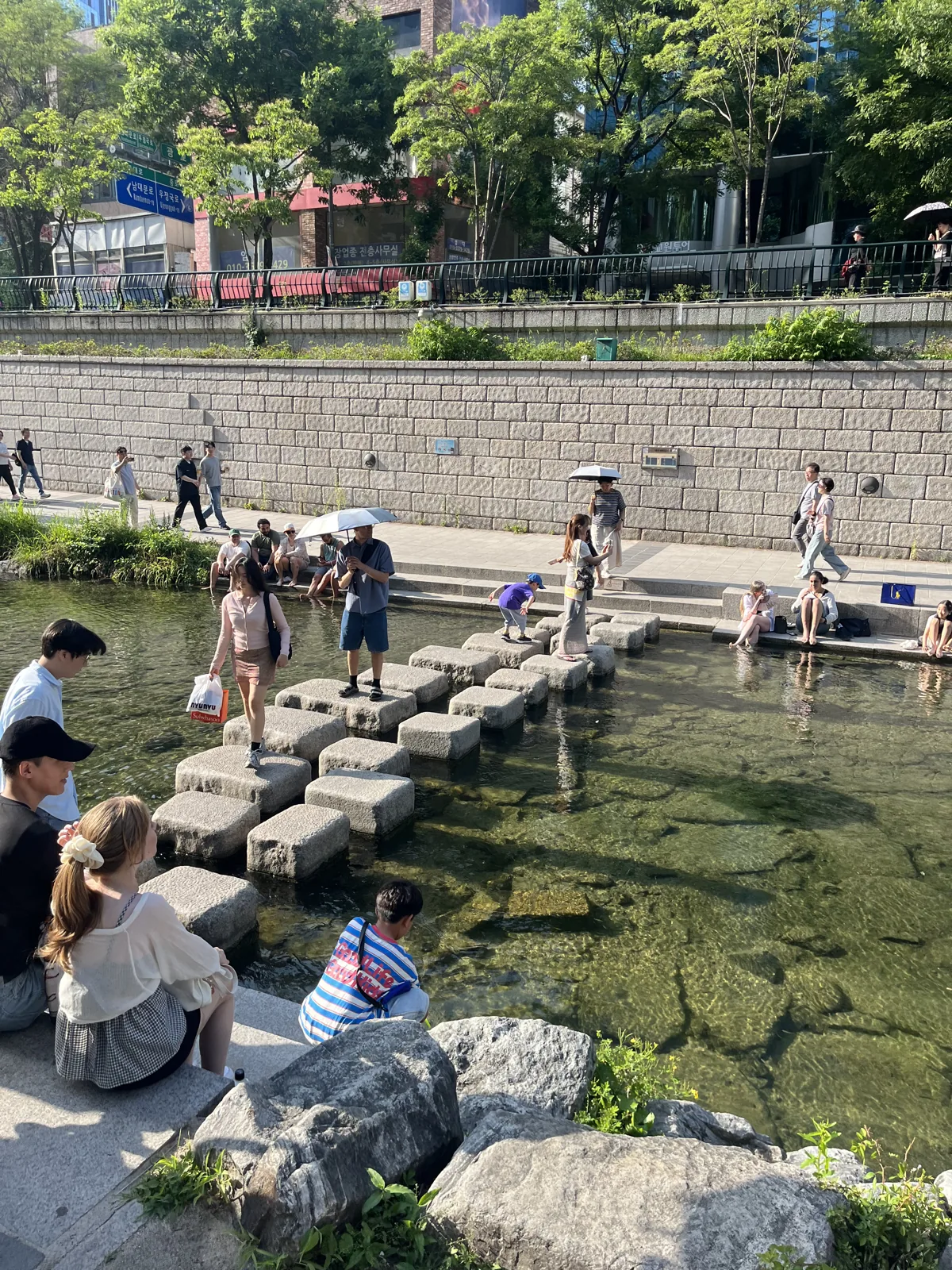
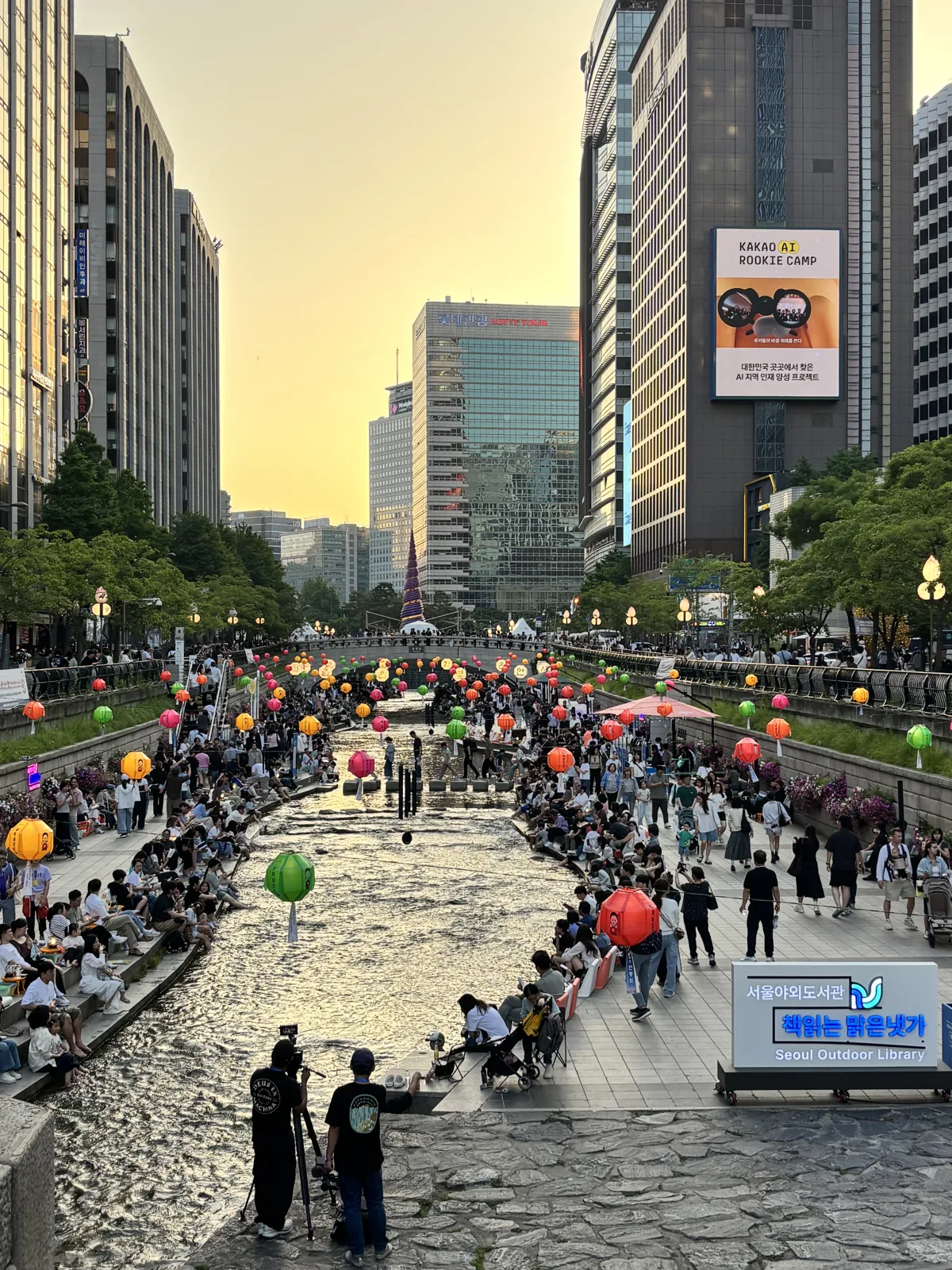
What you actually walk on is a sunken corridor below street level. Stone paths run along both banks, the water moves shallow and clear down the middle, and stepping stones let you hop across. Above you, the glass towers of Jongno and Euljiro rise on every side, so the whole time you are both deep in nature and deep in the city at once.
It starts at Cheonggye Plaza near Gwanghwamun, where a small cascade marks the source, and flows east past bridge after bridge. You do not need to walk the whole thing. Most visitors do the first kilometre or two, which holds the prettiest, busiest, most photogenic stretch, and then climb back up to street level whenever they have had enough.
Why a Cheonggyecheon Stream Walk in Seoul Is Worth It
The reason a Cheonggyecheon stream walk in Seoul works so well is the contrast. You are in the middle of a city of ten million people, and yet down by the water it goes quiet, the traffic noise drops away, and you hear the stream instead. That sudden shift from chaos to calm is the whole experience, and it never gets old for me.
It is also gloriously free and open all day, every day. There is no gate, no ticket, no opening hour to plan around. You can drop in for ten minutes between other plans or spend a slow hour wandering, and either way you have lost nothing. For a city that can drain your wallet fast, that matters.
Here is my honest Korea-versus-Australia moment. In Sydney, cooling off by water on a hot day means a drive to Bondi or queuing for a harbour pool, a whole half-day mission. On my last trip home, in the thick of a Seoul summer, I walked down a flight of concrete steps in the absolute middle of downtown, sat on a rock, and put my feet straight into cool running water. Office workers were doing the same on their lunch break. That casual, free access to water in the city core is something I genuinely miss when I am back in Australia.
And it is a real local space, not a tourist set piece. You will see couples on dates, grandmothers resting their feet, kids chasing each other across the stones, and the occasional white egret fishing in the shallows. For the fuller rundown of the best things to do here plus the classic after-dark version, my Cheonggyecheon Stream Seoul guide covers the seven highlights and the night walk in detail.
Where to Start and Which Way to Walk
I almost always start visitors at Cheonggye Plaza, the western source near Gwanghwamun and Jonggak. It is the easiest point to find, it has the little waterfall that marks the beginning, and the first stretch downstream is the most beautiful, so you walk into the best part rather than away from it.
From the plaza you walk east, with the water flowing the same direction you do. Within the first ten minutes you reach the early bridges and the famous stepping stones, where everyone slows down to take photos and cross the water. This opening kilometre is where the stream is widest, greenest, and most alive, and for many people it is all the Cheonggyecheon they need.
If you want more, keep going east and the crowds thin, the planting turns wilder, and it feels more like a green ribbon than a plaza. I love this quieter middle section on a hot afternoon because you actually get shade and space. Whenever you are done, a staircase up to street level is never far, and you simply rejoin the city.
The bridges are worth noticing as you go, because each one has its own character and they make handy landmarks. The early ones near the plaza are grand and busy, decorated and lit at night, while the ones further east are plainer and quieter. I use them to measure my walk rather than any map, telling friends to aim for the third or fourth bridge and then decide whether to carry on. It turns a featureless stroll into a set of small, easy goals, and it means you always know roughly how far you have come and how to get back up to a station.
What You Will See by Season
The stream changes character completely across the year, and the season you visit shapes the whole walk. I have done it in most of them, and each has a different reward, so it is worth knowing what is waiting before you go.
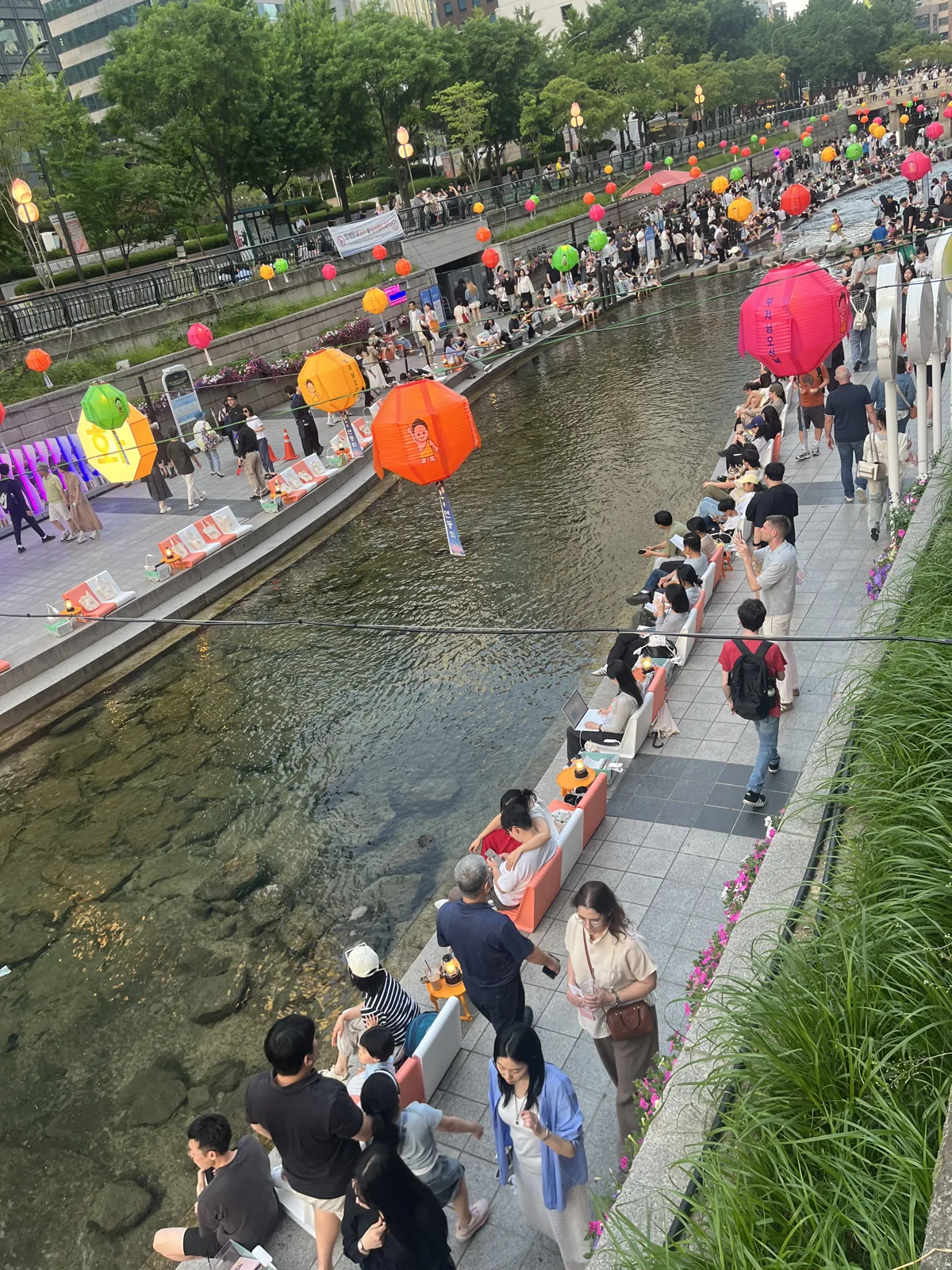
My favourite surprise is lantern season. Around Buddha’s Birthday in May, the city strings thousands of colourful paper lanterns the length of the stream, floating just above the water in pinks, oranges, and greens. At dusk they glow, the crowds gather along the banks, and the whole corridor turns into something out of a festival. If your trip lands anywhere near that window, prioritise an evening walk.
Summer is for the water itself. On hot days the banks fill with people dipping their feet, sitting on the rocks, and sheltering under the bridges, and the stream becomes the city’s free air conditioning. Autumn brings cooler, clearer light that is gorgeous for photos, and even grey, rainy days have a moody beauty as the wet stone darkens and the towers disappear into low cloud.
Winter is the version most visitors miss, and it has its own quiet charm. The crowds thin right out, the water keeps running, and in some years the city sets up a light display along part of the stream for the colder months. It is too cold to dip your feet, obviously, but a brisk ten-minute stretch wrapped up warm, with the towers lit and the path almost to yourself, is a completely different mood from the summer crush. Whatever season you land in, there is a reason to drop down to the water for a few minutes.
Cheonggyecheon at a Glance
Here is the stream boiled down to the essentials so you can slot it into your day without overthinking it. Treat the timings as a rough local’s guide rather than a strict rule.
| Detail | What to Expect |
|---|---|
| Cost | Free, open 24 hours, no ticket |
| Best start point | Cheonggye Plaza, near Gwanghwamun and Jonggak |
| How long to walk | First 1–2 km is enough for most visitors |
| Best season | May for lanterns, summer for dipping your feet |
| Best time of day | Late afternoon into dusk for the light |
| Nearest stations | Gwanghwamun, Jonggak, City Hall, Euljiro 1-ga |
Honest Tips Before You Go
A few practical things will make the walk smoother, and they are the kind of details I only know because I have got them wrong myself. None of this is essential, but it saves a little friction.
First, wear shoes you do not mind getting damp. The stepping stones sit just above the waterline, they can be slick, and after rain the stream runs higher and faster than it looks. Take your time crossing, especially with kids, and do not try to pose for a photo in the middle of a queue of people waiting to cross.
Second, there is very little shade in the wide opening section, so on a hot, sunny day bring a hat or water, or time your walk for late afternoon when the towers throw shade across the path. Third, the downstream stretches have fewer cafes and toilets, so use the facilities near the plaza end before you wander far. For the rest of central Seoul nearby, my Myeongdong travel guide picks up where this walk leaves off.
How It Fits Your Seoul Day
Cheonggyecheon works best as a connector rather than a destination, and that is its quiet genius. It sits right in the historic Jongno core, so it threads naturally between the big sights without you ever needing a taxi. You can walk from Gwanghwamun and the palaces, drop down to the stream, and pop back up near Insadong or the markets.
My favourite version is a late-afternoon walk that rolls straight into dinner. You stroll the stream as the light softens, climb up on the Jongno side, and you are minutes from some of the best grilled-meat restaurants in the city, as well as the historic stalls of my Gwangjang Market food guide a short walk away. That exact evening is what I wrote up in my Korean BBQ near Cheonggyecheon (11 November) guide, because the stream walk and the dinner really are one perfect pairing.
So do not treat this as a box to tick for fifteen minutes. Build a little loop around it, give it a slow hour at the right time of day, and let it be the calm green seam that holds a busy Seoul day together. That is how locals actually use it, and it is the version I would want a friend to have.
FAQ
Is the Cheonggyecheon stream walk free?
Yes, completely. Cheonggyecheon is a free public space with no gate, no ticket, and no opening hours, so you can walk it any time of day or night. There is nothing to book or pay for, which is a big part of why locals use it so casually. You only spend money if you stop at a cafe or restaurant nearby afterwards.
How long does it take to walk Cheonggyecheon?
Most visitors walk the first one to two kilometres from Cheonggye Plaza, which takes about thirty to sixty minutes at a relaxed pace with photo stops. The full stream runs nearly eleven kilometres if you want a longer walk. You can climb back up to street level at almost any bridge, so you control exactly how far you go.
When is the best time to visit Cheonggyecheon?
Late afternoon into dusk gives the best light and a cooler walk, especially in summer when the opening section has little shade. May is special because of the lantern displays around Buddha’s Birthday, and summer is when locals dip their feet in the water. Even rainy days have a moody charm, so there is no truly bad time.
How do I get to Cheonggyecheon?
The easiest start point is Cheonggye Plaza near Gwanghwamun and Jonggak, both a short walk from several subway lines. Gwanghwamun, Jonggak, City Hall, and Euljiro 1-ga stations all sit within a few minutes of the western end. Tap in with a transit card, walk to the plaza, and follow the water east.
Can you swim or put your feet in the stream?
You cannot swim, but putting your feet in the shallow edges is a normal summer thing that locals do all along the banks. The water is cool and clean enough for paddling, though you should watch your footing on the slick stones and never go in after heavy rain, when the stream runs higher and faster than it looks.
My Thoughts
Cheonggyecheon is the place I always end up at when I am home, often without planning to. I will be crossing town, see the steps down to the water, and just go. There is something about being beside a running stream while the city roars overhead that resets me every single time.
My honest advice is to stop treating it as a sight and start treating it as a walk. Pick the western plaza end, go in the late afternoon, and let yourself drift downstream with no fixed turnaround point. Dip your feet if it is hot, slow down if there are lanterns, and climb out whenever you feel like it.
It will not be the most dramatic thing you do in Seoul, and that is exactly the point. It is the calm bit, the free bit, the local bit. Give it an unhurried hour and it might quietly become your favourite memory of the city, the way it keeps being mine.
Planning Your Cheonggyecheon Walk?
Start at Cheonggye Plaza near Gwanghwamun, walk east with the water, and go in the late afternoon so you catch the light and the cooler air. Wear shoes you do not mind getting damp, take it slow on the stepping stones, and have dinner plans on the Jongno side for after. Use this as your map, pair it with the guides below, and you will do the stream the way a local would.