Disclosure: This post contains affiliate links. If you purchase through these links, I may earn a commission at no extra cost to you. As an Amazon Associate, I earn from qualifying purchases.
Korean BBQ at home for beginners can feel overwhelming — the equipment, the cuts, the timing. Twenty years ago, I moved from Busan to Sydney with my mum’s kimchi recipe and absolutely no idea how to explain any of it to my new Australian friends.
Back then, finding the right equipment was a nightmare. The right cuts of meat? Even harder. I made every mistake possible — wrong pan, wrong heat, wrong marinade timing. My first attempt at home galbi was so tough my husband thought I’d cooked leather.
Two decades later, I can do this in my sleep. And I want to save you the years of trial and error it took me to get here.
Table of Contents
- What Korean BBQ Actually Is (And Isn’t)
- The Equipment You Need (And What to Skip)
- The Three Meats to Start With
- Marinades: The Heart of Korean BBQ
- Banchan: The Side Dishes That Complete the Meal
- Beginner Equipment Comparison
- Step-by-Step: Your First Home Korean BBQ Session
- FAQ
- My Thoughts
- Related Links
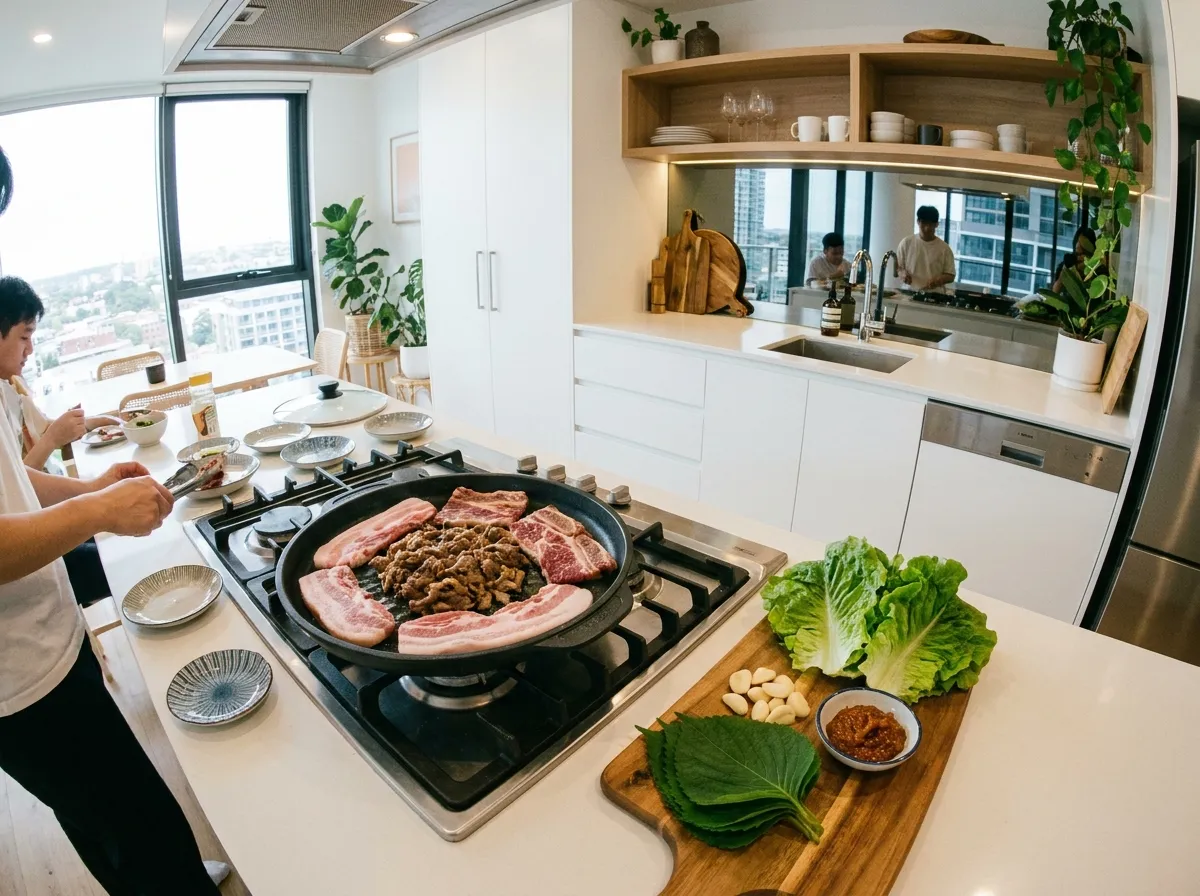
📸 The essential Korean BBQ home setup — grill pan, banchan side dishes, and fresh meat ready to cook on a stovetop in a home kitchen.
What Korean BBQ Actually Is (And Isn’t)
Let me clear something up right away. Korean BBQ is not a recipe. It’s not even really a cooking method. It’s a way of eating together.
In Korea, the grill sits in the middle of the table. Everyone cooks their own meat, wraps it in lettuce with a smear of ssamjang paste, a sliver of raw garlic, and a piece of green chilli. You eat it in one bite. You pour drinks for each other. You talk loudly. It’s communal, chaotic, and completely wonderful.
When I moved to Australia, the hardest part wasn’t finding the ingredients. It was recreating that feeling — the warmth of everyone leaning over the grill, the smell of charring meat, the rhythm of cooking and eating at the same time.
The good news is that you can absolutely recreate it at home. You just need to understand what you’re actually trying to achieve: a shared experience built around a grill in the middle of the table. Once you have that mindset, everything else falls into place.
The Equipment You Need (And What to Skip)
This is where most beginners overthink it. I’ve seen people spend $800 on a built-in table grill before they’ve even cooked their first batch of samgyeopsal. Don’t do that. Start simple, get comfortable, then upgrade if you want to. When it comes to grill pans specifically, I’ve tested quite a few and written a dedicated guide. Check out my recommendations for the best Korean BBQ grill pans for stovetop use — it covers what to look for and which ones are actually worth buying.
What You Actually Need
The most important thing is a grill pan with raised ridges. The ridges do two jobs: they create those attractive grill marks, and more importantly, they channel fat away from the meat so it grills rather than fries. I’ve used the TeChef Stovetop Korean BBQ Non-Stick Grill Pan for years. It’s PFOA-free, dishwasher safe, and the non-stick coating genuinely holds up after hundreds of uses.
If you prefer something more heavy-duty that will last a lifetime, the Lodge Cast Iron Square Grill Pan is an excellent alternative. Cast iron retains heat better than non-stick, which means more consistent searing. The trade-off is that it’s heavier and requires a little more care — but many home cooks swear by it.
What You Can Skip (For Now)
- Built-in table grills — Impressive but expensive. A stovetop pan works just as well for home cooking.
- Charcoal setups — Amazing flavour, but impractical indoors. Save this for outdoor entertaining.
- Commercial exhaust fans — Open a window and use your range hood. It’s enough.
- Expensive meat slicers — Ask your Korean grocer to slice the meat for you. Most will do it for free.
The Three Meats to Start With
Korean BBQ has dozens of cuts, but as a beginner, focus on these three. Master them first, then explore from there.
1. Samgyeopsal (삼겹살) — Pork Belly
This is your starting point. Pork belly is forgiving, widely available, and requires zero marinating. Slice it about 1cm thick, lay it on a hot grill, and cook until the fat renders and the edges crisp up. It takes about 3–4 minutes per side. Wrap in lettuce with ssamjang and eat immediately.
2. Bulgogi (불고기) — Marinated Beef
Thinly sliced beef marinated in a sweet-savoury sauce of soy, pear, garlic, and sesame oil. It cooks in under two minutes on a hot grill, which makes it perfect for beginners. The CJ bibigo Mild & Sweet Bulgogi Sauce is a reliable shortcut when you don’t have time to make the marinade from scratch — I keep it in my pantry for weeknight cooking.
3. Galbi (갈비) — Beef Short Ribs
This is the showstopper. Flanken-cut short ribs marinated overnight in a mixture of soy sauce, Asian pear, garlic, ginger, and sesame oil. The pear enzymes tenderise the meat in a way nothing else can replicate. Cook on high heat for 2–3 minutes per side. The caramelised edges are what Korean BBQ dreams are made of.
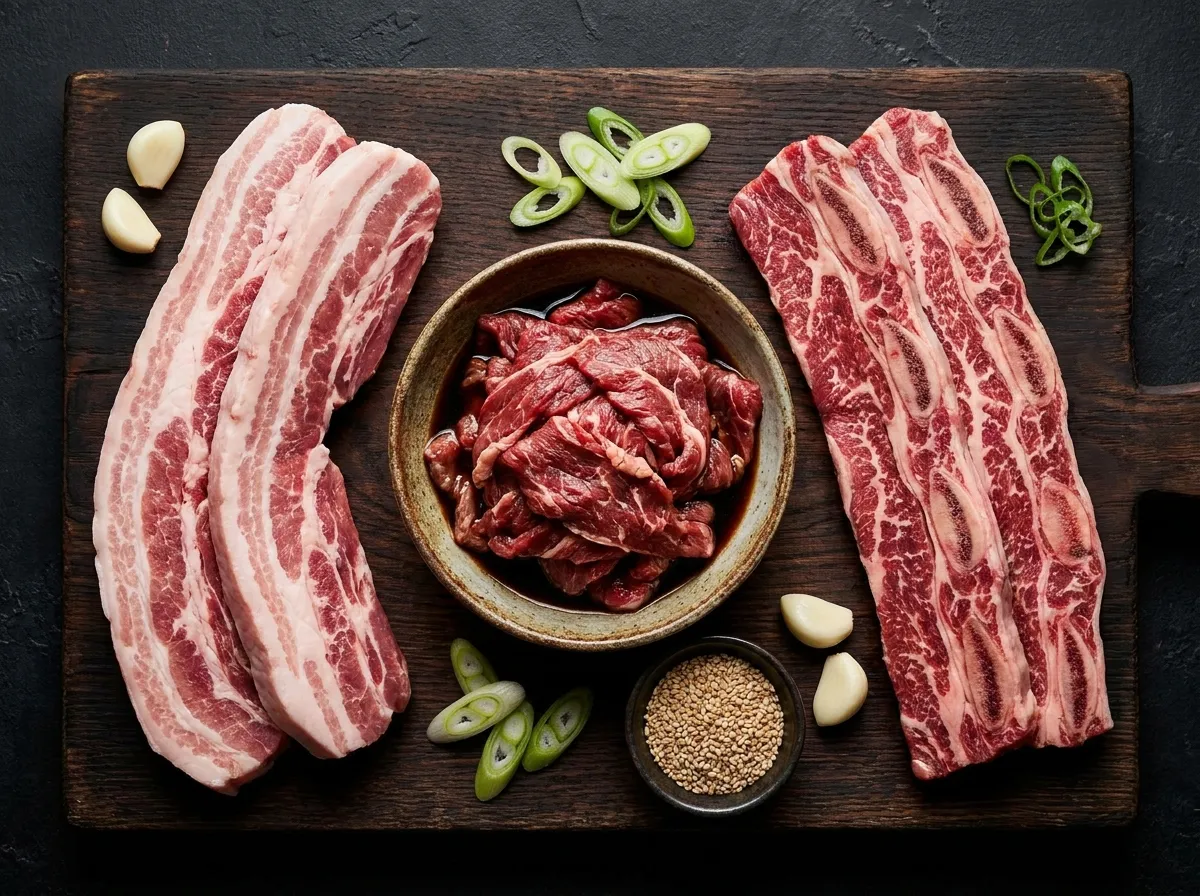
📸 Three essential Korean BBQ cuts for beginners — samgyeopsal, bulgogi, and galbi — arranged on a wooden board with fresh garlic and green onions.
Marinades: The Heart of Korean BBQ
A good marinade is what separates a memorable Korean BBQ from a forgettable one. The flavour profile you’re aiming for is a balance of salty, sweet, savoury, and slightly nutty — soy sauce for salt and umami, sugar or pear for sweetness, garlic and ginger for depth, sesame oil for that distinctive nuttiness. If you want to go deeper on galbi marinade specifically, I’ve written a full recipe post based on my mum’s Busan recipe. Our galbi marinade recipe from scratch explains every ingredient and why it matters — it’s a great starting point for your first home session.
Basic Bulgogi Marinade (From Scratch)
- 4 tbsp soy sauce
- 2 tbsp sugar
- 1 tbsp sesame oil
- 4 cloves garlic, minced
- ½ Asian pear, grated
- 1 tsp fresh ginger, grated
- 2 spring onions, finely sliced
- 1 tbsp toasted sesame seeds
Combine everything, coat your beef slices, and marinate for at least 2 hours. Overnight is better. The pear breaks down the muscle fibres and gives you that melt-in-your-mouth texture.
When You’re Short on Time
On busy nights, I reach for the CJ bibigo Mild & Sweet Bulgogi Sauce. It’s not identical to homemade, but it’s genuinely good — balanced, not too sweet, and it works on both beef and pork. Pour it over your meat, leave it for 30 minutes, and you’re ready to grill.
Banchan: The Side Dishes That Complete the Meal
Here’s something most non-Korean food guides get wrong: banchan is not a side dish. It’s half the meal. Once you’re confident with the basics, the next challenge is keeping the smoke under control. That comes down to ventilation, equipment choices, and cooking technique.
In Korea, a proper Korean BBQ spread has at least six banchan dishes on the table before the meat even hits the grill. Kimchi, kongnamul (seasoned bean sprouts), japchae (glass noodles), spinach namul, pickled radish, and egg custard are the classics. Each one is designed to complement the richness of grilled meat.
As a beginner, don’t try to make everything from scratch on your first attempt. Buy good quality kimchi from a Korean grocer — in Sydney, the kimchi from S Mart in Eastwood is excellent. Make one or two simple banchan yourself, like kongnamul or pickled cucumber, and buy the rest.
As your confidence grows, start making more from scratch. My mum’s kimchi recipe took me five years to get right. Don’t rush it.
Beginner Equipment Comparison
If you’re trying to decide which grill pan to start with, here’s an honest breakdown based on my experience with both options.
| Feature | TeChef Non-Stick Grill Pan | Lodge Cast Iron Grill Pan |
|---|---|---|
| Material | Aluminium with Teflon Select coating | Cast iron |
| Weight | Light — easy to handle | Heavy — takes practice |
| Heat retention | Good | Excellent |
| Non-stick performance | Excellent out of the box | Improves with seasoning over time |
| Cleanup | Dishwasher safe — very easy | Hand wash only — more effort |
| Durability | 3–5 years with care | Lifetime if maintained |
| Best for | Beginners, frequent use | Serious home cooks, outdoor use |
| Price range | ~$40–60 | ~$30–50 |
My honest recommendation: start with the TeChef. It’s forgiving, easy to clean, and produces great results immediately. Once you’re cooking Korean BBQ regularly and want something that will last forever, add the Lodge to your collection.
Step-by-Step: Your First Home Korean BBQ Session
Here’s exactly how to run your first session, from prep to table.
The Day Before
- Make your galbi or bulgogi marinade and coat the meat — overnight marinating makes a huge difference
- Prepare any banchan that improves with time (kimchi, japchae, pickled radish)
- Buy your ssam ingredients: butter lettuce, perilla leaves, ssamjang paste, raw garlic, green chilli
One Hour Before
- Take marinated meat out of the fridge — cold meat on a hot grill drops the temperature and prevents proper searing
- Prepare your banchan plates and set the table
- Slice any vegetables for wrapping
At the Table
- Heat your grill pan until you see a faint wisp of smoke — this is critical
- Start with samgyeopsal if you have it — it’s the most forgiving and gets everyone in the mood
- Cook in small batches so the pan stays hot — overcrowding drops the temperature
- Use scissors to cut cooked meat into bite-sized pieces directly on the grill — this is the Korean way
If you want to go deeper on technique and recipes, Korean BBQ: Master Your Grill in Seven Sauces by Bill Kim is the best English-language book on the subject. I’ve had my copy for six years and it’s covered in sauce stains — the highest compliment I can give a cookbook.
FAQ
How much meat should I prepare per person?
For a proper Korean BBQ session with multiple cuts and banchan, plan for about 200–250g of meat per person. If you’re serving only one or two cuts, go up to 300g. People always eat more than they expect when the grill is in the middle of the table.
Can I do Korean BBQ without a special grill pan?
Yes, a regular heavy-bottomed frying pan will work for your first attempt. But the difference a proper grill pan makes is significant — the ridges drain fat and create better texture. The TeChef Korean BBQ Grill Pan is affordable and makes an immediate difference to the results.
What’s ssamjang and where do I find it in Australia?
Ssamjang is a thick, savoury paste made from doenjang (fermented soybean paste) and gochujang (red chilli paste), mixed with garlic, sesame oil, and a little sugar. It’s the essential dipping sauce for Korean BBQ wraps. You’ll find it at any Korean grocery in Sydney — S Mart in Eastwood and Komart in North Strathfield both carry it. Look for the brown tub with Korean writing and a green lid.
How do I know when the meat is cooked properly?
For pork belly: cook until the fat is fully rendered and the edges are golden brown and slightly crispy — about 3–4 minutes per side on high heat. For bulgogi: it cooks very fast, 1–2 minutes per side. For galbi: 2–3 minutes per side, looking for caramelised edges. When in doubt, cut a piece and check — slightly pink in the centre for beef is fine, but pork should be cooked through.
Is Korean BBQ healthy?
Compared to many Western BBQ styles, Korean BBQ is actually quite balanced. The meat portions are smaller, you’re eating lots of vegetables through banchan and ssam wraps, and the marinades use natural ingredients like pear, garlic, and ginger. Samgyeopsal is high in fat, but galbi and bulgogi are leaner cuts. The biggest variable is how much you eat — and with a grill in the middle of the table, it’s easy to lose track.
My Thoughts
Twenty years ago, I cried the first time I tried to make galbi in my Sydney apartment. The meat was tough, the marinade was off, and it tasted nothing like home. I called my mum in Busan and she talked me through it for an hour over the phone.
That’s the thing about Korean BBQ that no recipe can fully capture: it carries memory. Every time I set up the grill at home, I’m back at my parents’ table in Busan, watching my dad manage the fire and my mum refill the banchan dishes without being asked.
If you’re just starting out, be patient with yourself. Your first session won’t be perfect. Your marinade might be too sweet or your pan might not be hot enough. That’s fine. Korean BBQ is a skill that improves with practice, and the practice itself — the cooking, the eating, the sharing — is the whole point.
Start simple. Get the grill pan. Buy good quality meat. Call someone you love and invite them over. The rest will come.
Start Your Korean BBQ Journey Today
The TeChef Stovetop Korean BBQ Grill Pan is the best starting point for beginners — non-stick, easy to clean, and produces restaurant-quality results on a home stovetop. → Check the latest price on Amazon
And if you want to learn Korean BBQ techniques from a professional chef in Seoul, the Traditional Korean 6-Dish Cooking Class with Hidden Alley Tour in Seoul is an unforgettable experience.
Related Links
If you found this article helpful, you might also enjoy these related guides:
- The Best Korean BBQ Grill Pans for Stovetop Use (Tested at Home) — A detailed review of the two grill pans I’ve tested over 20 years, with an honest comparison.
- How to Make Galbi Marinade from Scratch (My Mum’s Busan Recipe) — The overnight marinade recipe that transforms beef short ribs into something extraordinary.
- Samgyeopsal vs Galbi — Which Korean BBQ Cut Should You Start With? — A detailed comparison of the two most popular cuts to help you decide where to begin.
- The Ultimate Korean BBQ Party Guide for Hosting at Home in Australia — How to scale up your setup for a group, with a full prep timeline.
- Where to Buy Korean BBQ Ingredients in Sydney (A Local’s Guide) — Exactly where to find every ingredient you need, from S Mart to online options.
- 5 Korean BBQ Dipping Sauces You Need to Know (Beyond Ssamjang) — The sauces that complete the Korean BBQ experience, with recipes and pairing guides.