Disclosure: This post contains affiliate links. If you purchase through these links, I may earn a small commission at no extra cost to you. I only recommend products I personally use and trust.
The first time I brought an Australian friend to Myeongdong, she nearly bought a ₩12,000 sheet-mask set she would have paid ₩4,000 for two streets over. That is exactly why I wrote down these Myeongdong tourist tips — the small, practical things that save you money, time, and the slightly panicked feeling of being a target. I grew up in Korea and have lived in Sydney for twenty years, so I walk Myeongdong as both a local who knows the shortcuts and a visitor who remembers what it feels like to be lost.
Why Myeongdong Trips People Up
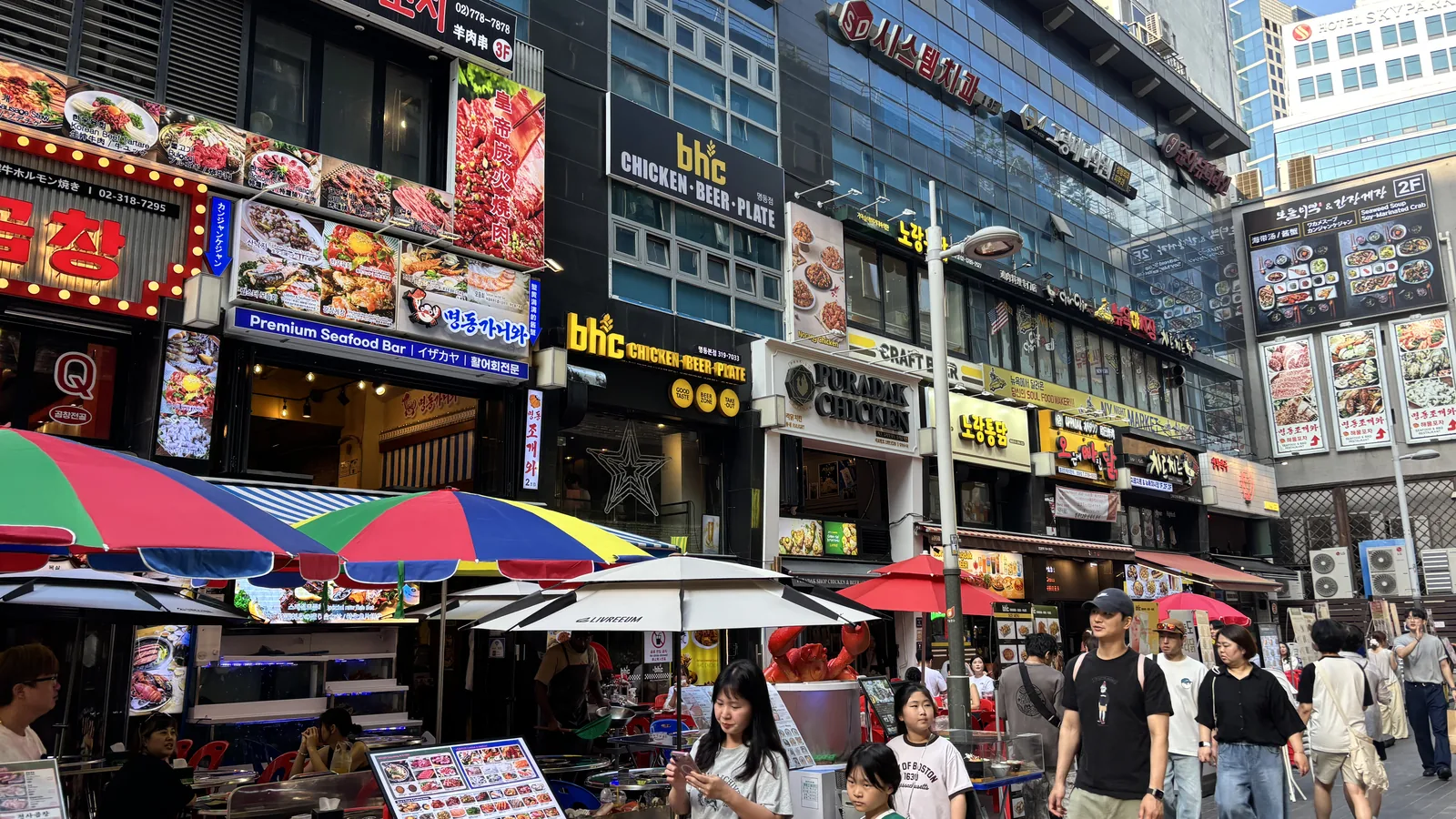
Myeongdong is the most visitor-facing square kilometre in all of Seoul, and that is exactly what makes it confusing. Everything is built for tourists, which sounds helpful, but it also means the prices, the touts, and the crowds are all calibrated for people who do not know any better. The good news is that the patterns are very learnable.
The first thing that trips people up is timing. Myeongdong is half-asleep in the morning and a carnival by night, so a 10am visitor and a 7pm visitor see two completely different neighbourhoods. Show up at the wrong hour and you either find shuttered shops or a crush you cannot move through.
The second thing is money. Between cash-only food stalls, card-friendly flagships, tax-refund desks, and currency touts, it is easy to either overpay or carry the wrong kind of money. I have watched visitors hand over a card at a stall that only takes cash, then queue at an ATM that charges a brutal foreign fee.
The third is the hard-sell. The cosmetics street in particular runs on free samples and friendly pressure, and it works on first-timers every time. None of this is dangerous — Myeongdong is one of the safest places I know — but it rewards a little preparation. If you want the full lay of the land first, my Myeongdong travel guide walks through the whole area before you arrive.
My Honest Myeongdong Day Routine
When I take someone through Myeongdong now, I run the same loop every time, and it has saved me from every mistake I am about to warn you about. I start late morning, around 11am, when the shops are open but the crowds have not landed yet. The light is good, the streets breathe, and you can actually browse.
I do the serious shopping first — cosmetics, fashion flagships, anything I want to think about — while my head is clear and the aisles are walkable. I keep one card for the big stores and a small fold of cash for later. By mid-afternoon I break for a proper sit-down meal, not stall food, because the stalls are an evening event and I want to pace the day.
Here is my honest Korea-versus-Australia moment. In Sydney, a “shopping day” in the CBD means parking fees, a thirty-minute drive, and maybe two streets of stores before I am done. In Myeongdong I tap into the subway for ₩1,400, walk out of the station into the middle of everything, and never get in a car. The density is the whole gift — for the price of one Sydney parking session, I can ride the metro all day.
Then I let the evening arrive. From about 6pm the food stalls fire up, the neon comes on, and the street turns into the version of Myeongdong everyone photographs. I eat my way down the lane, do any late shopping in the stores that stay open until 10pm or 11pm, and tap back onto the subway before the last-train rush. That single rhythm — shop calm, eat loud, leave easy — is the backbone of every good Myeongdong day.
The Myeongdong Tourist Tips That Matter Most
If you only remember a handful of things, make it these three. They cover when to go, how to pay, and where to base yourself, and they are the questions every visitor I help ends up asking.
Timing and getting around
Getting to Myeongdong is genuinely easy once you have a T-money card, which you buy at any convenience store and top up at the station machines. Myeongdong Station sits on subway Line 4, and Euljiro 1-ga on Line 2 is an easy walk from the north end, so two of Seoul’s busiest lines drop you right at the edge of the district. From Incheon Airport, the AREX train plus one transfer gets you here in about 70 to 90 minutes; an airport bus is slower but lands you closer to the hotels with luggage. Exits 5, 6, 7, and 8 from Myeongdong Station all feed into the shopping streets, so pick whichever your hotel app points to. For timing, weekday late mornings are the calm window, and weekend evenings are the crush — if you hate crowds, never arrive on a Saturday at 7pm.
Money, tax refund and payment
Most flagship stores, department stores, and restaurants take card without blinking, and contactless works on everything. The street-food stalls are the exception — many are cash-only or have a card minimum, so carry ₩20,000 to ₩30,000 in small notes for an evening of snacking. Tax refunds are where tourists leave money on the table. Spend ₩15,000 or more in a single store displaying a “Tax Free” sign, keep your passport on you, and you can claim the VAT back either instantly at the store’s refund desk or at an airport kiosk on the way out. The instant in-store refund is the easiest, and big Myeongdong cosmetics shops are set up for it. For the full mechanics of doing this with skincare hauls, my guide to the Olive Young tax refund breaks down every step I use.
Where to stay and avoiding traps
Staying in or right beside Myeongdong is, honestly, worth it for a first Seoul trip. You roll out of the hotel into the shopping and food, you can drop bags between the morning and evening sessions, and you are a short subway hop from Gyeongbokgung, Insadong, and Namsan. There are hotels at every price point within a five-minute walk of the main drag, plus a row of guesthouses up the quieter slopes toward Namsan. The trap to avoid is assuming “closest to the neon” equals “best” — rooms one street back are quieter at night and often cheaper. Book something with good transit access over something with a flashy lobby, and your feet will thank you.
Avoiding the Hard-Sell and Overpriced Traps
The hard-sell is the part of Myeongdong that catches kind, polite visitors most, because the pressure is wrapped in friendliness. Staff outside cosmetics shops will press free sheet masks into your hands, call you over with a warm smile, and then steer you toward a “today only” bundle. The samples are real and free; the urgency is theatre.
My rule is simple: accept the free sample, smile, and never buy on the first pass. Walk the street, note the prices, and come back if something is genuinely cheaper. The same sheet-mask pack can swing wildly in price between two shops fifty metres apart, and the touts count on you not checking. A quiet five-minute price comparison is the most powerful Myeongdong tourist tip I can give you.
Street-food stalls have their own version of this. A few well-placed tourist-trap stalls charge double for a tornado potato or a grilled-cheese lobster, betting that you will not know the going rate. The fix is to glance at where Korean office workers and students are actually queuing — locals will not pay ₩15,000 for a snack, so follow the line, not the loudest sign. For a deeper look at how that whole shopping street works, my Seongsu-dong Seoul travel guide shows the calmer, more local-priced contrast across town.
The last trap is the currency-exchange and “fake” goods corners. Use a proper exchange booth or withdraw from a bank ATM rather than the first stall with a glowing rate board, and skip the street-stall “luxury” knock-offs entirely — customs back into Australia takes a dim view of counterfeits.
When the crowds and the sales pressure wear you down, the smartest move is to book one calm thing in advance so your day has a guaranteed off-switch. An Art de la peau aesthetic and massage treatment in Myeongdong is the quiet reset I slot into a busy shopping day, away from the touts and the noise.
Myeongdong Survival at a Glance
Here is the quick-reference version I wish someone had handed me on my first foreigner-eyes trip through the district.
| Situation | What to Do | Rough Cost | My Tip |
|---|---|---|---|
| Getting around | T-money card, Line 4 (Myeongdong) or Line 2 (Euljiro 1-ga) | ₩1,400 per ride | Buy T-money at any convenience store first |
| From the airport | AREX train + one transfer, or airport bus | ₩4,000–17,000 | Bus is slower but easier with big luggage |
| Street food | Carry small cash; follow the local queue | ₩3,000–6,000 a snack | Skip any stall charging double “tourist” prices |
| Cosmetics | Take samples, compare, claim tax refund | Refund on ₩15,000+ spend | Never buy on the first hard-sell pass |
| Where to stay | Hotel one street back from the main drag | Varies widely | Prioritise transit access over a flashy lobby |
English Support and Safety
One thing that surprises first-timers is how little Korean you actually need in Myeongdong. This is the most English-ready district in Seoul. Flagship stores keep English-speaking staff, signage leans on pictures and global brand names, and the cosmetics shops in particular employ people who switch languages mid-sentence for tourists.
Beyond the shops, the official tourist infrastructure is genuinely good. There is a tourist information centre near the main intersection with English-speaking staff and free maps, and Korea runs a 1330 travel helpline that answers in English around the clock — I have called it myself to settle a debate about closing times. The Korea Tourism Organization site lists those centres and the helpline, and Visit Seoul keeps up-to-date transit and event details for the area. Translation apps handle the rest, and most menus in the area carry English or photos.
On safety, Myeongdong is about as low-risk as a busy city district gets. Violent crime is rare, the streets stay lively and lit well into the night, and solo travellers, including women, generally feel comfortable here long after dark. The realistic risks are pickpocketing in the densest evening crush and simple overpaying, not anything frightening. Keep your bag zipped and in front of you when the food street gets shoulder-to-shoulder, and you have covered the only real precaution.
I will be honest with you: the biggest “danger” in Myeongdong is your own wallet. Between the samples, the snacks, and the late-night sales, the district is engineered to separate you from your won gently and happily. Knowing that going in is half the battle — and it is also exactly what makes the place so much fun.
FAQ
What are the most important Myeongdong tourist tips for a first visit?
Arrive late morning on a weekday for calm shopping, then return in the evening for the food stalls and neon. Buy a T-money card for the subway, carry small cash for cash-only stalls, and keep your passport handy to claim tax refunds on spends over ₩15,000. Never buy from the first hard-sell pass — compare prices first.
How do I get to Myeongdong from Incheon Airport?
The fastest route is the AREX airport train to Seoul Station, then a quick subway transfer to Myeongdong on Line 4, taking about 70 to 90 minutes total. An airport limousine bus is slower but drops you closer to the Myeongdong hotels and is easier if you have heavy luggage. Both are far cheaper than a taxi.
Is cash or card better in Myeongdong?
Carry both. Flagship stores, department stores, and sit-down restaurants all take card and contactless without issue. The street-food stalls are the exception — many are cash-only or have a card minimum, so keep ₩20,000 to ₩30,000 in small notes for an evening of snacking.
Is Myeongdong safe at night?
Yes, Myeongdong is one of the safest districts in Seoul, even late at night. The streets stay busy and well-lit, and solo travellers generally feel comfortable after dark. The only realistic risks are pickpocketing in the densest evening crowds and overpaying at tourist-trap stalls, so keep your bag zipped and compare prices.
Where should I stay near Myeongdong?
Stay within a five-minute walk of the main drag so you can drop bags between the morning and evening sessions. Rooms one street back from the neon are quieter at night and often cheaper than the flashiest hotels. Prioritise good subway access over a fancy lobby, since Lines 2 and 4 connect you to the rest of Seoul.
My Thoughts
Myeongdong gets a bad rap from some travellers as “too touristy,” and I understand why, but I think that misses the point. It is touristy because it is genuinely good at being a visitor’s first taste of Seoul — easy transit, English everywhere, food and shopping packed into a few walkable blocks. Knowing the small tricks just turns a slightly overwhelming district into a smooth one.
My honest advice is to lean into what Myeongdong does well and stay alert to what it does to your wallet. Do your real shopping when it is calm, eat when it is loud, base yourself close so you can pace the day, and treat every “today only” deal with a raised eyebrow. None of that takes effort once you have done it once.
If you want a slower, more local counterpoint after a Myeongdong day, hop across town and let the neighbourhood show you a different speed of Seoul. But for your first arrival, Myeongdong is still the easiest place in the city to find your feet — and now you know how to do it without overpaying for a sheet mask.
Planning Your Myeongdong Day?
After a day of walking and dodging the hard-sell, the nicest reward is a proper rest. A booked O HUI & WHOO spa and massage session takes the ache out of your feet, and it sells out fast on weekends, so I would lock it in before you arrive.
📌 Before you go: know your numbers
The best Myeongdong tip? Know your budget before you arrive. Between the beauty hauls, street food, and cafe stops, it’s one of Seoul’s easiest places to blow past your limit.
Set your Myeongdong spending limit with this calculator →