Disclosure: This post contains affiliate links. If you purchase through these links, I may earn a small commission at no extra cost to you. I only recommend products I personally use and trust. As an Amazon Associate, I earn from qualifying purchases.
This galbi marinade recipe from scratch is the one I rebuilt over twenty years of phone calls from Sydney to Busan. My mum never wrote it down — not once in forty years. She learned it from her mother, who learned it from hers, and somewhere along the way the measurements became instinct.
This is my galbi marinade recipe from scratch — the one I rebuilt over three years of failed attempts and long-distance phone calls from Sydney to Busan. Too sweet. Too salty. Not tender enough. She talked me through it every single time. This is the result.
Table of Contents
- What Is Galbi and Why Does the Marinade Matter So Much?
- The Ingredients (And Why Each One Matters)
- The Recipe: Step by Step
- Choosing and Preparing the Meat
- How to Cook Galbi at Home
- Homemade vs Store-Bought Marinade
- FAQ
- My Thoughts
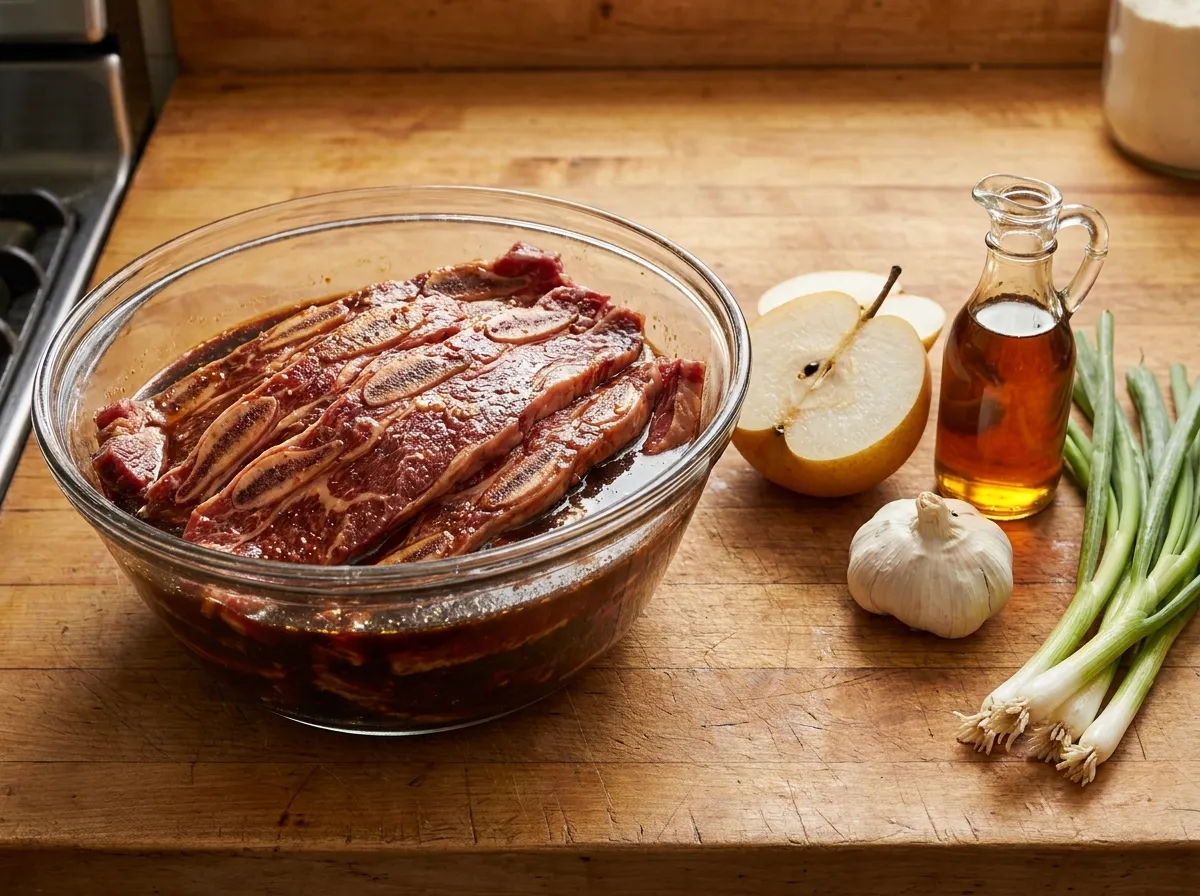
📸 Galbi short ribs marinating overnight in my mum’s Busan recipe — soy sauce, Asian pear, garlic, and sesame oil in a deep glass bowl.
What Is Galbi and Why Does the Marinade Matter So Much?
Galbi (갈비) means “ribs” in Korean. In the context of Korean BBQ, it almost always refers to beef short ribs cut in the flanken style — sliced across the bone so each piece has three small bone sections running through it. This cut exposes more surface area to the marinade and the grill, which is why galbi develops such intense flavour. If you’re still deciding between galbi and samgyeopsal for your next session, our side-by-side breakdown of samgyeopsal vs galbi will help you figure out which cut suits your setup and skill level best.
The marinade isn’t just about flavour. It’s also doing structural work. The enzymes in Asian pear break down the tough muscle fibres in short ribs, transforming what would otherwise be a chewy cut into something that melts against your teeth. Skip the pear and you’ll notice immediately — the meat will be tighter, less yielding, less satisfying.
This is why galbi is considered one of the more impressive dishes in Korean BBQ. Done properly, it’s extraordinary. Done carelessly — wrong marinade, not enough time, wrong heat — it’s just expensive tough beef.
The Ingredients (And Why Each One Matters)
Every ingredient in this marinade has a specific job. Understanding what each one does helps you adjust the recipe confidently when you need to substitute something. Once you’ve mastered the marinade, the next step is building out your full setup. Our Korean BBQ at home for beginners guide walks through equipment, banchan, and everything else you need for the complete experience.
Soy Sauce — The Foundation
Use a good quality Korean soy sauce if you can find it. It’s slightly less salty and more complex than Japanese soy sauce. If you can only find Japanese soy sauce, reduce the quantity by about 20% to avoid over-salting.
Asian Pear — The Tenderiser
This is the ingredient most non-Korean recipes omit, and it’s the most important one. Asian pear contains proteolytic enzymes that physically break down muscle fibres. Grate it finely so the enzymes are fully released into the marinade. If you can’t find Asian pear, kiwi fruit works — but use half the quantity, as kiwi enzymes are more aggressive.
Garlic — The Depth
Fresh garlic only. Garlic powder is not a substitute here. Mince it as finely as possible so it distributes evenly through the marinade and doesn’t burn on the grill.
Sesame Oil — The Finish
Sesame oil is added last and in small quantities. It doesn’t tenderise or season — it adds a distinctive nutty aroma that is unmistakably Korean. Don’t be tempted to add more than the recipe calls for. A little goes a long way.
Sugar and Mirin — The Caramelisation
Sugar creates the caramelised crust that forms on the surface of galbi when it hits a hot grill. Mirin adds a more complex sweetness and helps the marinade adhere to the meat. Don’t skip either.
The Recipe: Step by Step
This makes enough marinade for approximately 1kg of galbi short ribs.
Ingredients
- 6 tbsp soy sauce
- 3 tbsp sugar
- 2 tbsp mirin
- 1 tbsp sesame oil
- 6 cloves garlic, finely minced
- 1 tsp fresh ginger, grated
- ½ Asian pear, grated (about 100g)
- 3 spring onions, finely sliced
- 1 tbsp toasted sesame seeds
- ½ tsp black pepper
Method
- Combine soy sauce, sugar, and mirin in a bowl and stir until the sugar dissolves completely
- Add minced garlic, grated ginger, and grated Asian pear — stir to combine
- Add sesame oil, spring onions, sesame seeds, and black pepper
- Taste the marinade before adding the meat — it should be savoury, slightly sweet, and fragrant
- Score the meat lightly with a knife to help the marinade penetrate
- Coat the ribs thoroughly and refrigerate for a minimum of 4 hours — overnight is strongly preferred
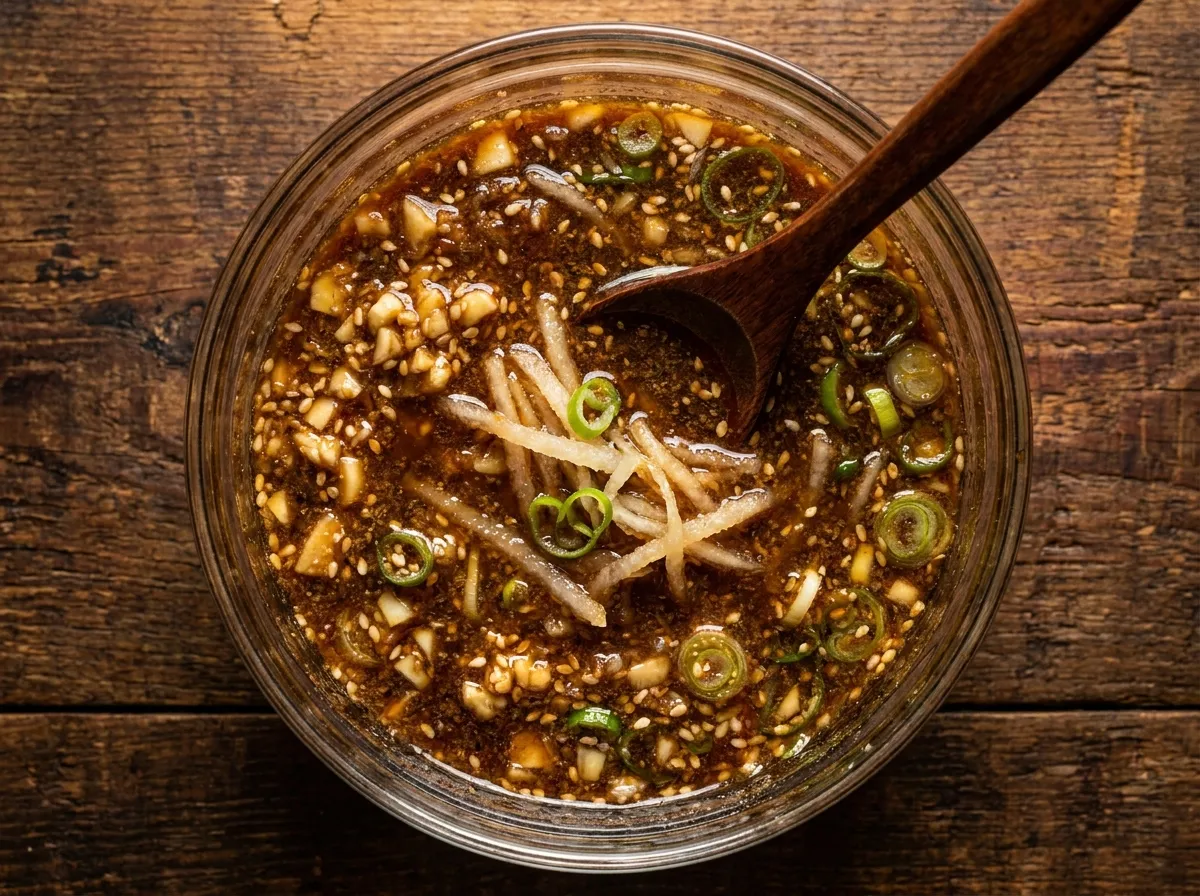
📸 Freshly made galbi marinade in a glass bowl — the deep brown colour comes from soy sauce and mirin, with grated Asian pear visible throughout.
Choosing and Preparing the Meat
The marinade can only do so much. The quality and preparation of the meat matters just as much.
What to Buy
Ask for flanken-cut beef short ribs — sliced across the bone, about 1cm thick. In Sydney, S Mart in Eastwood stocks this cut pre-sliced in the Korean style. Some mainstream butchers will cut it for you if you ask in advance. Avoid thick-cut short ribs meant for braising — they won’t cook properly on a grill.
Scoring the Meat
Before marinating, make shallow diagonal cuts across the surface of the meat on both sides. This isn’t strictly necessary but it helps the marinade penetrate deeper and creates more surface area for caramelisation on the grill.
Marinating Time
Four hours is the minimum. Overnight is ideal. More than 24 hours and the pear enzymes can over-tenderise the meat, making it mushy. The sweet spot is 8–12 hours — which makes this a perfect make-ahead dish for a weekend dinner.
How to Cook Galbi at Home
After all that marinating, the cooking itself is surprisingly quick. Galbi cooks fast on high heat — the goal is caramelised edges and a slightly charred surface, not slow cooking. The cooking surface you use makes a real difference with galbi. If you’re using a stovetop, check out our tested recommendations for the best Korean BBQ grill pans for stovetop use — the right pan gives you better char and easier cleanup.
- Bring the meat to room temperature for 30 minutes before cooking
- Heat your grill pan to high — wait for a faint wisp of smoke before the meat goes on
- Shake off excess marinade before placing on the grill — too much liquid will steam the meat
- Cook 2–3 minutes per side, depending on thickness
- Look for caramelised, slightly charred edges — that’s when it’s ready
- Use scissors to cut into bite-sized pieces directly on the grill
When you’re short on time and can’t make the marinade from scratch, CJ Beksul Pork Bulgogi Spicy Sauce works well as a quick substitute — it’s one of the better store-bought options I’ve found in Australia. The flavour profile is close to homemade and it caramelises nicely on the grill.
Homemade vs Store-Bought Marinade
| Factor | Homemade (This Recipe) | Store-Bought (CJ Beksul) |
|---|---|---|
| Flavour depth | Complex, layered | Good, slightly one-dimensional |
| Tenderising effect | Excellent (fresh pear enzymes) | Moderate |
| Prep time | 10 minutes + marinating | 2 minutes |
| Customisable | Fully | No |
| Cost | ~$3–4 per batch | ~$8–10 per bottle |
| Best for | Weekend cooking, guests | Weeknights, quick meals |
FAQ
Can I use this marinade for other meats?
Absolutely. This marinade works beautifully on pork belly, chicken thighs, and even firm tofu. For chicken, reduce the marinating time to 2–4 hours. For tofu, 1–2 hours is enough. The Asian pear tenderising effect is most dramatic on beef, but the flavour works across all proteins.
What if I can’t find Asian pear?
Kiwi fruit is the best substitute — use half the quantity as it’s more enzymatically active. Grated apple works too, though it’s less effective as a tenderiser. In a pinch, omit the fruit entirely and just marinate longer — 24 hours instead of overnight.
Can I freeze marinated galbi?
Yes, and it’s actually a great meal prep strategy. Marinate the meat, portion it into freezer bags, and freeze for up to three months. Thaw overnight in the fridge before cooking. The texture holds well and the flavour is excellent.
Why is my galbi tough even after marinating overnight?
Two likely causes: the cut of meat is wrong (you need flanken-cut, not thick braising ribs), or the marinade didn’t have enough pear. Make sure you’re using fresh Asian pear — not canned, which has been heat-treated and has no enzymatic activity. Also check that you’re cooking on high heat, not medium — galbi needs a fast, hot sear, not slow cooking.
My Thoughts
Every time I make this marinade, I think about my mum. About the way she’d taste it with her finger, adjust something without measuring, and hand me the spoon to try. About the phone calls from Sydney where she’d patiently explain what I was doing wrong while I stood in my kitchen, frustrated and homesick.
Food carries memory in a way nothing else does. This recipe is twenty years of phone calls, of getting it wrong and trying again, of slowly understanding what my mum’s hands knew instinctively. I hope it does the same thing for you — connects you to something, or someone, worth remembering.
Make it once from scratch. Then make it again. By the third time, you’ll start to feel when it’s right without measuring. That’s when it becomes yours.
Make Galbi Tonight
If you want to go deeper into Korean BBQ marinades and techniques, Korean BBQ: Master Your Grill in Seven Sauces by Bill Kim is the best English-language resource I’ve found.
And for nights when you don’t have time to make the marinade from scratch, CJ Beksul Pork Bulgogi Spicy Sauce is the best store-bought option I’ve found in Australia.
Related Links
If you found this article helpful, you might also enjoy these related guides:
- Korean BBQ at Home for Beginners — What I Wish I Knew Sooner — The complete guide to setting up and cooking Korean BBQ at home, from equipment to banchan.
- Samgyeopsal vs Galbi — Which Korean BBQ Cut Should You Start With? — A detailed comparison of the two most popular Korean BBQ cuts to help you decide where to begin.
- 5 Korean BBQ Dipping Sauces You Need to Know — The essential sauces that complete every Korean BBQ spread, including ssamjang and beyond.