Disclosure: This post contains affiliate links. If you purchase through these links, I may earn a small commission at no extra cost to you. I only recommend products I personally use and trust.
When I first moved from Seoul to Australia in 2006, my vintage finds from Hongdae’s backstreet shops were the only pieces in my wardrobe that didn’t look like everyone else’s. Two decades later, returning home every few years, I still experience that same electric thrill crawling through the narrow alleys between Hongik University and the Han River. Vintage shopping in Hongdae Seoul isn’t just about finding old clothes—it’s about unlocking Seoul’s creative DNA, one overlooked rack at a time.
Table of Contents
- Why Hongdae Is Seoul’s Vintage Shopping Hub
- Understanding the Hongdae Vintage Scene: Tourist Traps vs. Genuine Gems
- The Best Vintage Stores in Hongdae: My Tested List
- What to Look For: K-Fashion, 90s Treasures, Vintage Denim & Accessories
- Haggling and Pricing: What’s Normal in Hongdae?
- The Hongdae Free Market: When and Why to Go
- How to Style Korean Vintage Finds Back Home
- My Final Thoughts on Hongdae’s Vintage Culture
- FAQ
Why Hongdae Is Seoul’s Vintage Shopping Hub
If you’re hunting for authentic vintage shopping in Hongdae Seoul, you’re already in the right neighbourhood. Hongdae—short for Hongik University—sits on Seoul’s northwest edge, where art students, musicians, and creative rebels have squatted since the 1990s. This isn’t the polished Gangnam we export to the world. This is where Korean artists fought to build something real before real estate prices swallowed the neighbourhood whole.
I grew up watching Hongdae transform from a rough warehouse district into Seoul’s spiritual counterweight to commercialism. While Myeongdong sold you what corporations wanted, Hongdae sold you what artists were actually wearing. That DNA—that refusal to follow the mainstream—is still woven through its vintage scene. When I walk those streets now, the energy hasn’t fundamentally changed. It’s just more expensive and slightly more Instagram-aware.
What makes vintage shopping in Hongdae Seoul different from other districts is the depth of supply. These aren’t retail boutiques selling “vintage-inspired” pieces. These are curators who’ve spent years building relationships with estate liquidators, university students selling their parents’ 80s collections, and Korean fashion archives. Hongdae’s vintage stores exist because the neighbourhood attracts people who actually care about fashion history—not just people who want a photo for social media.
The comparison between Hongdae and other Seoul vintage hotspots matters here. If you’re comparing where to spend your vintage hunting time, you’ll want to understand how Hongdae and Seongsu-dong compare for creative culture. Both neighbourhoods have artistic roots, but they’ve evolved differently. Hongdae has remained younger, more student-focused, with cheaper rents and more experimental shops. Seongsu-dong skews slightly more refined—factory conversions into design studios rather than university kids selling their closets.
Understanding the Hongdae Vintage Scene: Tourist Traps vs. Genuine Gems
Let me be blunt: about 60% of what advertises itself as “vintage” in Hongdae is not vintage. It’s fast fashion rebranded. It’s cheap synthetics with a faded print. It’s new clothing that’s been pre-distressed to look old. And yes, there are shops deliberately targeting Instagram tourists with inflated prices and Instagram-bait window displays.
After 20 years away, when I return to Hongdae, I can spot the tourist traps within five minutes. They have these tells: English signage plastered everywhere (genuine shops assume you speak Korean or you’ll ask), racks arranged for aesthetics rather than browsing (pretty but impractical), and prices that feel 30-40% higher than they should be for the quality. The “vintage” styling is immaculate—which is itself suspicious. Real vintage is messy. Real vintage stores smell faintly of old fabric and time.
Here’s what separates genuine Hongdae vintage from the tourist cafés: the owners aren’t performing their love of vintage; they’re obsessive about it. They can tell you the year a piece was manufactured by looking at the tag. They know which Korean designers from the 70s are collectible. They’ll spend 10 minutes explaining why one deadstock leather jacket is worth triple the price of a similar-looking piece. This isn’t snobbishness—it’s expertise.
I’ve learned to look for three red flags that signal a trap: (1) if the store’s Instagramming feels more important than the actual curation, pass. (2) If they’re only accepting card payments at inflated prices, that’s a sign they’re not integrated into the neighbourhood economy—move on. (3) If you ask “is this actually vintage?” and the owner gets defensive, they know something you don’t.
The Best Vintage Stores in Hongdae: My Tested List
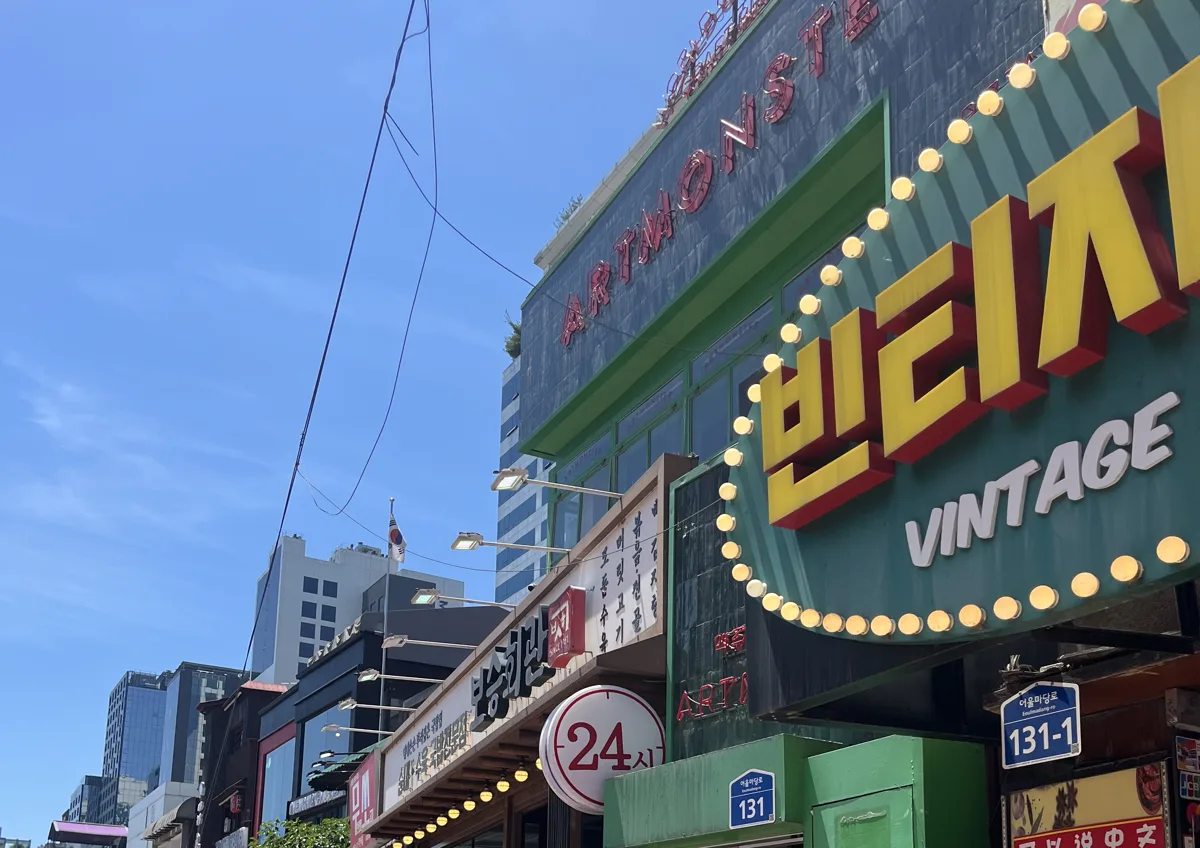
📸 Hongdae’s backstreets are dotted with vintage stores — this neon sign is a local landmark. Taken by me in Hongdae, Seoul.
I’m about to share something I’ve protected for years: my personal map of Hongdae’s best vintage stores. These aren’t ranked by Instagram popularity—they’re ranked by the genuine treasures I’ve found walking out with pieces I still wear in Australia, and the quality of conversation I had with the owner.
| Store Name / Area | Specialty | Price Range (KRW) | Tourist-Friendly? | Unnie’s Tip |
|---|---|---|---|---|
| Vintage Vinyl Garden / Near Hongik Univ. Station, Exit 9 | 70s-90s Korean & Western denim, leather jackets, concert tees | 15,000–80,000 | Somewhat—English basic | Owner buys directly from university clothing drives. Ask about pieces not on display. They hold inventory in back. |
| Archive Studio / Hongdae Alley (near ARKO Art Center) | Curated seasonal collections, 80s Sportswear, K-designer archival pieces | 25,000–150,000 | No—Korean preferred | This is where Seoul fashion students buy for research. Pieces rotates weekly. Visit midweek to catch new arrivals before the Saturday rush. |
| Moonlight Closet / Wausan-ro (main vintage strip) | 90s K-fashion, Y2K handbags, deadstock shoes | 12,000–55,000 | Yes—Instagram-aware owner | Great for tourists who actually want authentic pieces, not Instagram props. Prices are fair; quality control is strict. Stock changes Wednesdays. |
| Oldmoon Records & Clothing / Side alley parallel to Wausan-ro | Vintage vinyl bundled with matching-era clothing (a unique concept) | 8,000–120,000 | No—owner barely speaks English | Owner only accepts cash. Prices seem random but are actually negotiable if you show genuine interest. I bought my favourite 80s Hyundai promotional jacket here for 6,000 KRW. |
| Piece by Piece / Near Hongdae High School | Luxury vintage (designer archives, museum-quality pieces), Italian leather goods | 60,000–500,000+ | Yes—high-end retail experience | This is investment-level vintage. I don’t shop here for everyday pieces, but their sourcing is impeccable. Visit if you’re collecting, not hunting. |
| Dongdae Vintage / Hongdae Station area (slightly less touristy) | 80s-00s mixed inventory, oversized blazers, workwear, denim | 10,000–45,000 | Somewhat—owner is patient | Owner’s wife is a tailor in the back room. If you find something that almost fits, ask if they can alter it. Unofficial service but they often say yes. |
These six stores represent what I consider “the guaranteed finds” zone. You won’t leave empty-handed, but more importantly, you won’t leave feeling ripped off. I’ve personally tested every one, and I’ve brought Australian friends through each shop without embarrassment.
What to Look For: K-Fashion, 90s Treasures, Vintage Denim & Accessories
When you’re vintage shopping in Hongdae Seoul, the question becomes: what are you actually hunting for? The answer shapes your entire experience.
Korean Fashion Archives (70s–90s): This is where Hongdae specialists. Korean brands from the 70s and 80s—names you won’t recognize in English but that signal serious curation to Korean eyes—are collectible for a reason. A 1987 Jinro Sports jacket isn’t famous internationally, but it represents Korea’s first generation of domestic fashion confidence. I own three Korean vintage pieces that I wear more than anything from Western brands. They fit differently (Korean tailoring assumes a smaller shoulder, longer torso) and they carry genuine history. When shopping Korean vintage, ask the owner about the brand’s history. You’re not just buying a jacket; you’re buying a narrative about Korean industrial design from a specific era.
90s Aesthetics: The 1990s are the sweet spot of Hongdae vintage because Seoul itself was transforming in the 90s. You’ll find pieces that capture that exact moment—oversized blazers, low-rise everything, neon accents, chunky accessories. For Australian shoppers, the 90s-era pieces translate incredibly well to contemporary styling because grunge and 90s minimalism are cyclical trends. A 1994 Levi’s vintage jacket will genuinely look good in Melbourne in 2026.
Vintage Denim: This deserves its own paragraph because it’s the most reliable Hongdae treasure. Korean vintage denim from the 80s-90s tends to be constructed differently than American denim—tighter, with unusual pocket placements and washes that range from “barely worn” to “lived-in perfection.” Prices are 40-60% cheaper than equivalent vintage American denim, and quality is comparable. I bring back three pairs every trip to Australia. The trick is checking the tag for actual manufacturing date (look for 1980s print style) and understanding that Korean sizing runs smaller—what’s labeled a 32 might fit like a 30 in US sizing.
Accessories & Deadstock: This is where tourists sometimes miss the best deals. Hongdae is loaded with deadstock—never-worn inventory from closed department stores or cancelled orders. Deadstock vintage isn’t aged; it’s just old stock. Shoes, belts, sunglasses, scarves from the 80s-90s that have literally never been worn. They’re cheaper than “worn vintage” because they lack the cool factor, but they’re often higher quality and will last longer. I bought deadstock sunglasses for 5,000 KRW (about 4 AUD) that are now cult-favorite 80s frames.
Haggling and Pricing: What’s Normal in Hongdae?
This is where cultural context matters. If you’re coming from Australia or Western shopping culture, Hongdae pricing might feel either shockingly cheap or strangely ambiguous. Here’s the reality: haggling is normal, but it’s contextual.
At the tourist-facing stores (Moonlight Closet, Piece by Piece), prices are fixed. They’re already fair-market. Don’t haggle there—it’ll feel rude and it won’t work. At the genuine local shops (Oldmoon Records, Archive Studio), prices are often negotiable if you’re buying multiple pieces or spending serious time in conversation. The haggling isn’t about “getting a deal”—it’s about respect. If you spend 30 minutes genuinely browsing, asking questions, showing interest in the owner’s curation philosophy, they’ll often knock 10-15% off your total purchase. It’s a relationship-building ritual, not a haggle battle.
Here’s what I tell Australian friends: spend the first visit at mid-range shops where prices are transparent. Get a feel for the market. Then, on return visits, you can navigate the more opaque pricing at collector-focused shops. The owner at Oldmoon Records who quoted me 6,000 KRW for a promotional jacket had already watched me spend 40 minutes in his shop, trying on pieces, asking about his sourcing. The price wasn’t random—it was a gesture of goodwill for genuine interest.
One more rule: if a price seems wildly high compared to similar pieces, ask directly: “Is this rare?” or “Why is this more expensive?” A good owner will explain (deadstock condition, rare Korean designer, original tags, exceptional fabric). A bad owner will get defensive. That’s your signal to leave.
The Hongdae Free Market: When and Why to Go
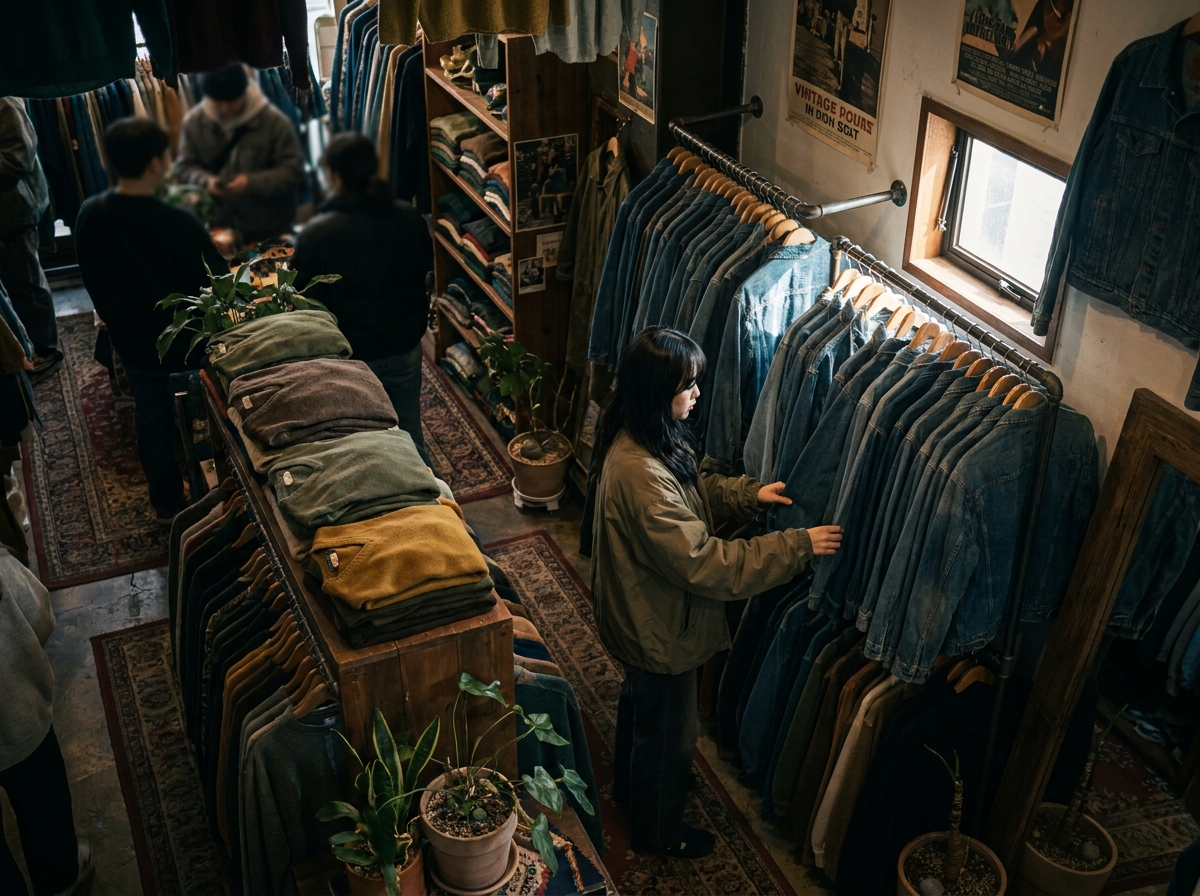
📸 A curated vintage boutique — rows of denim jackets, folded knitwear, and vintage posters, the more organised counterpart to the Free Market’s chaos. Visualized by unniespicking.com using Nano Banana Pro AI
The Hongdae Free Market happens most Saturdays and some Sundays (check ahead—schedules shift seasonally). It’s a completely different hunting ground from vintage boutiques. Vendors range from students selling their closets, to vintage collectors running pop-up stalls, to handmade designers mixing in. This isn’t the high-curation experience of Archive Studio; this is chaos and serendipity.
I include the Free Market in my vintage shopping in Hongdae Seoul recommendations because it teaches you what the neighbourhood actually values. You see what young Seoul wears, what they’re abandoning, what they’re reviving. I’ve found some of my strangest and best pieces at the Free Market—a 1970s beaded shoulder bag for 8,000 KRW, an oversized 80s Adidas windbreaker, perfectly worn jeans from someone’s university closet.
Strategy for the Free Market: arrive early (10 AM opening, best selection 10-1 PM), bring cash (most vendors aren’t set up for cards), and accept that you’re not searching for specific pieces—you’re finding unexpected things. The owner of Vintage Vinyl Garden told me she gets her best pieces from Free Market vendors who are just trying to clear closet space. That’s where the deals are, but you need time and luck.
If you’re planning a Hongdae weekend, the Free Market connects beautifully with the broader creative scene. Explore the Seongsu-dong craft workshop scene if you want to expand your shopping beyond vintage clothing into the broader maker culture. Or check out our best cafes in Hongdae Seoul for post-shopping refuelling locations—you’ll need them after hours of hunting.
How to Style Korean Vintage Finds Back Home
This is where my 20 years in Australia inform my advice. Korean vintage pieces are constructed differently, sized differently, and carry a different aesthetic energy than Western vintage. When you bring them home, there’s an integration question: how do you wear 1985 Seoul in 2026 Melbourne or Sydney?
👉 Here’s a Hongdae combination I genuinely recommend: buy a vintage outfit in the morning, then book a Korean-style Photo Shooting Experience for the afternoon. Wear what you just found. The photos come out extraordinary.
Size Reality: Korean vintage runs small. A Korean size L from the 80s fits like an Australian M or even S. You need to either find pieces that are genuinely oversized (the look they were designed for), or accept a fitted silhouette that feels tighter than you’re used to. This actually works for 90s Y2K styling—the tightness was intentional. But for 70s or 80s pieces, you’re often looking at the intentional oversized drop-shoulder aesthetic. Shop for fit intention, not numerical sizing.
Color Palettes: Korean vintage uses color differently. Korean designers favored jewel tones, earth tones, and unexpectedly bright accents in ways that differ from American vintage. A 1985 Korean windbreaker might be burnt orange with teal striping—a combination that would never appear in Western 80s fashion. This is actually brilliant for Australian wardrobes because it feels fresh and specific. The key is to treat these pieces as statement items, not basics. Pair a bold Korean vintage piece with neutral fundamentals.
Styling Korean Vintage in Warm Climates: Here’s what I’ve learned: Australian summers don’t require heavy jackets, so I focus on Korean vintage knitwear, oversized shirts, and lightweight blazers. A 1980s Korean linen blazer is perfection for Perth or Brisbane. Deadstock Korean shoes from the 80s-90s pair beautifully with contemporary minimalist Australian fashion. The aesthetic feels intentional rather than costume-y.
Durability Check: Korean vintage from the 70s-80s tends to be better constructed than Western equivalents from the same era—this is Korean manufacturing pride showing. However, check seams, check fabric integrity, check zippers before buying anything you plan to wear regularly. I always ask shop owners, “Have you worn this? Does it feel durable?” Their answer reveals whether it’s a display piece or an actual wearable.
For broader context on integrating Seoul finds into your personal style, check out our Seoul neighbourhood guide which includes styling advice for different district aesthetics. You’ll understand how vintage from different Seoul neighbourhoods carries different energy—Hongdae’s is youthful and experimental, while vintage from Itaewon or Gangnam carries different cultural weight.
My Final Thoughts on Hongdae’s Vintage Culture
When I was 15, my mother took me to a shop in Hongdae called “Yesterday’s Dream.” It doesn’t exist anymore—the building is a coffee franchise now. But that shop shaped how I think about vintage completely. The owner, a woman in her 60s, explained that every piece in her shop was a conversation. A 1970s skirt wasn’t just fabric; it was a story about that person’s life, their job, their aesthetic choices. When you wore vintage, you were inheriting that conversation. You were giving it a second chapter.
I think about this every time I return to Hongdae. The neighbourhood has gentrified. Rents have tripled. Some of the small vintage shops have become franchise stores. Some have upsized into more professional retail operations. But the philosophy remains: these pieces matter because they carry actual history.
Here’s what I want you to understand about vintage shopping in Hongdae Seoul: it’s not a treasure hunt for Instagram aesthetics. It’s an education in fashion history, in Korean design, in the way a neighbourhood preserves its own story through clothing. When you’re walking those backstreets in Hongdae, you’re walking through Korea’s first generation of urban creative culture. You’re shopping through a story.
And yes, you’ll find incredible pieces. Yes, you’ll pay less than you would anywhere else. Yes, you’ll leave with things that feel genuinely rare. But the real treasure is the conversation you have with an owner who’s spent 15 years curating a shop because they actually care about vintage. That’s what Hongdae offers. That’s what it’s always offered.
Ready to Hunt? Here’s Your Next Step
If you’re planning a Seoul trip and vintage shopping in Hongdae Seoul is on your list, start with research on specific shops before you arrive. Check their Instagram (yes, even genuine shops have presence now), note their cash/card policies, understand their opening hours. Bring comfortable shoes, bring a translation app, and bring genuine curiosity. The best finds happen when you’re not rushing.
→ Hongdae ring-making workshop by University of Rings — reserve on Klook (affiliate link)
→ K-pop idol hair, makeup and photoshoot experience — book on Klook (affiliate link)
Both sit a few minutes from the vintage streets, so they slot into the same afternoon.
And if you do find something amazing—or if you find a hidden gem shop I haven’t listed—I’d love to know. Unnie’s Picking is built on shared knowledge about finding real, beautiful, intentional pieces. Your discoveries matter.
Come back and tell me what you found.
Related Content on Unnie’s Picking
- Hongdae Seoul travel guide — my full Hongdae walkthrough after twenty years of coming back to it
- best cafes in Hongdae Seoul — the cafes I actually return to, tested and ranked
- things to do in Hongdae on a weekend — a morning-to-midnight plan if you only get one Hongdae day
- How Hongdae and Seongsu-dong compare for creative culture — how Seongsu and Hongdae compare for a creative day out
- Seongsu-dong craft workshop scene — the hands-on workshops if you want to make something
- Seoul neighbourhood guide — the everything-Seongsu overview beyond just the shopping
Frequently Asked Questions
Q: What’s the best time of year to vintage shop in Hongdae?
A: Spring (April-May) and autumn (September-October) are ideal. Summer brings crowds and the humidity affects the experience; winter means fewer Hongdae Free Markets. I always visit in May because the weather’s perfect and shops refresh their inventory after the spring season. That said, consistency matters more than timing—if you’re in Seoul, go. The pieces will be there.
Q: Do I need to speak Korean to shop at Hongdae vintage stores?
A: Not for the tourist-friendly shops like Moonlight Closet or Piece by Piece. For more local shops, basic Korean or Google Translate helps. But honestly? Genuine interest in pieces transcends language. If you spend time carefully examining items and showing respect for curation, owners will engage with you regardless of language. I’ve had 30-minute conversations with zero shared language—just pointing, smiling, and mutual enthusiasm.
Q: Are prices negotiable at vintage stores in Hongdae?
A: It depends on the shop. Tourist-facing stores have fixed prices. Local shops with opaque pricing are negotiable if you’re buying multiple pieces or showing genuine interest. Never haggle as an opening move. Spend time first, ask questions, then naturally inquire about discounts for multiple purchases. It’s relationship-based, not transaction-based.
Q: What should I look for to identify authentic vintage vs. fast fashion masquerading as vintage?
A: Check tags first—authentic vintage has manufacturing tags typical of its era. Check fabric quality; synthetic blends feel different from natural fibres used in older construction. Ask the owner directly about the piece’s origin. Check wear patterns; authentic vintage shows age in specific places (collar rubs, sleeve cuffs, seams). If the “distressing” looks uniform and manufactured, it’s fast fashion. Real vintage wears organically.
Q: How much should I budget for a vintage shopping trip to Hongdae?
A: You can find quality pieces for 15,000-30,000 KRW (about 12-24 AUD) at genuinely good shops. You could easily spend 100,000+ KRW (80+ AUD) if you’re buying multiple pieces or targeting luxury vintage. My strategy: budget for 3-4 pieces in the 25,000-50,000 KRW range, which gives you quality without breaking the bank. Bring 300,000-500,000 KRW (240-400 AUD) if you want serious shopping flexibility.
Q: Can I ship purchases back to Australia, or should I travel with them?
A: Small shops don’t typically offer shipping. Most owners expect cash transactions and immediate purchase. Plan to travel with your finds or arrange shipping yourself through a parcel service. I always check luggage space before shopping—it prevents me from overbuying and means I’m intentional about selections. Vintage pieces are often worth the luggage space.