🌎 Table of Contents
- Introduction
- The Story Behind KTX
- Riding KTX – More Than Just Speed
- How KTX Shapes Korean Life
- Practical Tips for Travellers
- KTX vs Australian Travel
- The Future of KTX
- Why KTX Is a Must-Experience
- Conclusion – Korea vs Australia Through the Lens of Rail
- Related Travel Guides
Introduction
If you’re planning intercity travel in Korea, the simplest upgrade is choosing the KTX Korea Train Express over a domestic flight. The KTX Korea Train Express turns a long cross-country trip into a compact, work-friendly ride: you board in the city centre, place your bag overhead, and the scenery flashes past before you finish your coffee. In this guide, I share practical tips from years of riding the system—seat choices, holiday timing, and booking steps—so you can make the most of KTX without guesswork
When I think about modern Korea, few innovations symbolise its speed, precision, and ambition like the KTX (Korea Train Express). I still remember my very first ride on the KTX from Seoul to Busan. It was a hot summer afternoon in the early 2000s, and I had just come back to Korea after living in Australia for a few years. At that time, I was so used to long domestic flights in Australia—flying from Sydney to Melbourne or Brisbane was just part of life. In contrast, sitting on a train that could cover nearly 400 kilometres in about two and a half hours felt nothing short of futuristic.
Over the years, I’ve taken KTX dozens of times—sometimes for family visits, other times for business, and occasionally just to rediscover Korea’s different cities. What always strikes me is not just the speed, but the way KTX represents a uniquely Korean blend of efficiency, affordability, and accessibility. It’s not just a train—it’s a symbol of how Korea redefined domestic travel.
The Story Behind KTX
The KTX launched in 2004, after decades of planning and investment. At first, many Koreans were sceptical. Would people pay more for a faster train when the existing Saemaeul and Mugunghwa trains already connect the country? The answer turned out to be a resounding yes. Within a year, millions of passengers were already embracing this new mode of travel.
I personally saw the cultural shift. Before KTX, most of my friends in Korea thought of Busan as a weekend-long destination—you had to commit to a slow train ride or a long bus journey. After KTX, Busan suddenly became a place you could visit for a single-day trip. That shift in perception reshaped not only domestic tourism but also business mobility. Today, KTX is part of everyday life, and it is hard to imagine Korean travel without it.
Riding KTX: More Than Just Speed
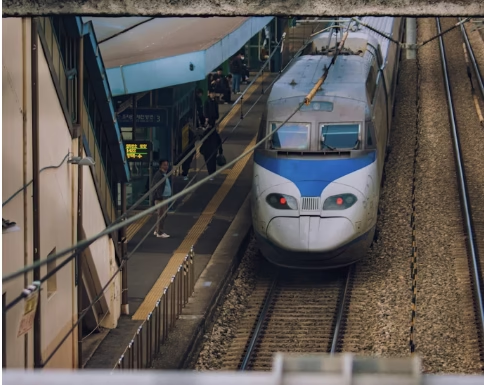
KTX isn’t just about getting somewhere fast. For me, it’s also about comfort and reliability. The train interiors are spacious compared to low-cost airlines. Wi-Fi is available on most routes, and I’ve often managed to finish entire work projects during rides. The seats recline just enough for a quick nap, and the ride is smooth with almost no turbulence—something you never get on planes.
One memorable experience was travelling during Chuseok, Korea’s Thanksgiving holiday. Roads were jammed for hours, and flights were fully booked. Yet, on KTX, I reached my destination on time without stress. It reminded me how in Australia, public transport between major cities is limited, making cars and planes almost the only option. Korea, on the other hand, has invested in a rail system that makes mass travel manageable even during peak holidays.
👉Want to explore Busan after your KTX ride? Check our Busan travel guide for beaches, markets, and the famous Haeundae coastline.
How KTX Shapes Korean Life
The biggest impact of KTX, in my opinion, is how it has shrunk the size of Korea. When you can travel from Seoul to Gwangju in two and a half hours or to Busan in just over two hours, the country feels smaller and more connected. Business people can attend morning meetings in Seoul and evening events in Busan without the hassle of airports. Families can plan spontaneous weekend trips without worrying about long travel times.
There’s also a social aspect. KTX stations are often hubs of urban development. Just look at Busan Station or Daejeon Station—the surrounding areas have transformed with new hotels, shopping centres, and restaurants, all feeding off the passenger flow. It’s similar to how Melbourne’s Southern Cross Station grew into more than just a train hub.
Practical Tips for Travellers
Having used KTX frequently, I’ve picked up some tips that first-time riders might find useful:
- Book early during holidays: Tickets can sell out quickly during Chuseok, Seollal (Lunar New Year), and long weekends.
- Use the Korail website or app: It’s straightforward and available in English. You can also book KTX tickets here.
- Consider the rail passes: If you’re a tourist, the KR Pass offers unlimited rides for a set period—great value if you plan multiple trips.
- Arrive 15 minutes early: Stations are big, and trains leave on time. There’s no waiting like with flights.
- Pack snacks: While there are vending machines, I prefer grabbing gimbap or coffee at the station convenience stores before boarding.
If you are planning to explore Korea beyond the high-speed rail, it helps to understand the public transport system in Seoul. Subways, buses, and commuter lines connect smoothly with the KTX Korea Train Express, making transfers easy even for first-time visitors. For a full guide, check our transport guide, which explains how to use T-money cards, subway maps, and transfer rules.
If you’re planning to explore Korea beyond the high-speed rail…
👉 Taxis in Korea: A Complete 2025 Guide for Foreign Travellers
Landing in Korea before your KTX trip? Make your first journey into Seoul smooth and stress-free.
Read the full guide → Taxis in Korea: A Complete 2025 Guide for Foreign Travelers (2025 Updated)
👉 If you’re starting from Seoul Station, make sure your T-Money Card is ready for subway or taxi transfers.
Learn more from T-Money Card Korea 2025 – How to Ride Seamlessly Across Seoul.
KTX vs. Australian Travel
Having had many travelling experiences in Australia for a period of many years, I can’t help but compare. The distances between major cities are vast, and high-speed rail has never truly taken off despite decades of debate. Travelling from Sydney to Melbourne still typically requires a one-hour flight plus airport waiting time, which easily adds up to 3–4 hours. KTX, in contrast, covers a similar distance in less time and with fewer hassles.
The cultural difference is also striking. In Korea, people see trains as everyday transportation, not just a scenic journey. In Australia, long-distance trains are often marketed as leisurely experiences rather than practical alternatives. I remember taking the XPT train from Sydney to Brisbane once—it was an overnight trip of nearly 14 hours! While beautiful, it was nothing like the convenience of hopping on a KTX.
This comparison highlights how infrastructure reflects national priorities. Korea invested heavily in rail because its dense population and smaller landmass made it ideal. Australia, with its vast geography and lower population density, leaned toward air travel.
The Future of KTX
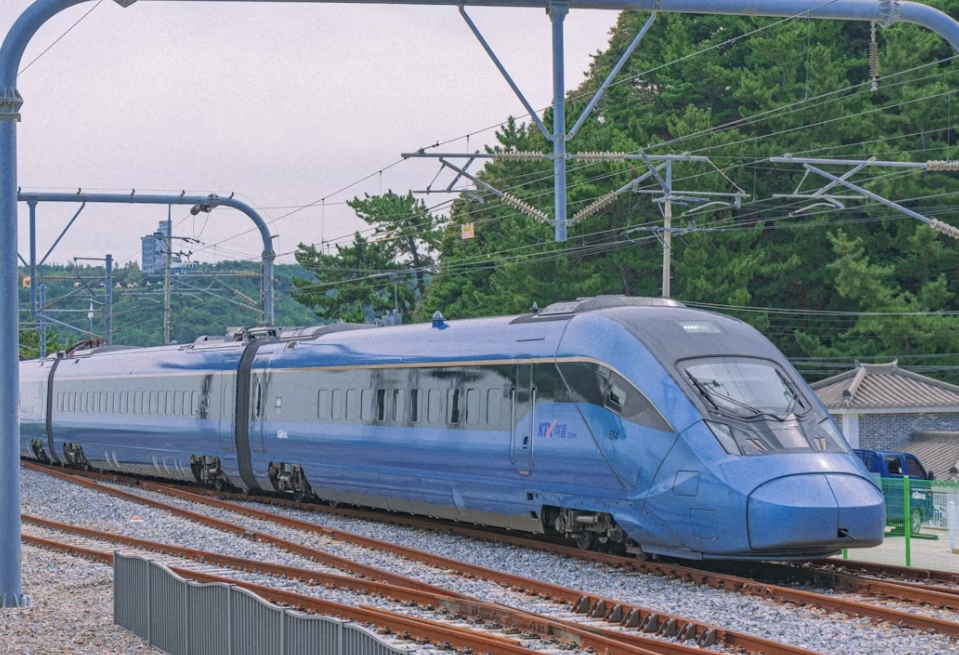
KTX is still evolving. The newer KTX-Eum trains, launched in 2021, are more eco-friendly and stylish, serving routes like Gangneung on the east coast. There’s also ongoing discussion about expanding true high-speed lines and even connecting to the yet-to-be-developed maglev systems. Korea is also looking outward—exporting its high-speed rail technology to other countries.
Personally, I think the future of KTX is about integration. Imagine a seamless connection between airports, subways, and high-speed rail, reducing the need for cars even further. It’s the kind of vision that could inspire places like Australia, where discussions about high-speed rail between Sydney, Canberra, and Melbourne keep resurfacing but rarely materialise.
Why KTX Is a Must-Experience
If you’re visiting Korea, riding the KTX is not just about convenience—it’s a cultural experience. You see the landscape blur past, watch cities give way to mountains, and feel the pulse of modern Korea. It’s fast, efficient, and uniquely Korean.
I’ve often told my Australian friends who visit Korea: “Skip one domestic flight and take the KTX instead. You’ll understand the country better.” And almost all of them come back saying it was one of their trip highlights.
Conclusion: Korea vs. Australia Through the Lens of Rail
Living in Australia for over two decades, I’ve often wished we had a system like KTX. It’s not just about saving time—it’s about transforming how people connect with their own country. Korea invested in making its cities feel closer, and it worked. Australia, on the other hand, still relies heavily on planes and highways, which reflects its vast size and different lifestyle patterns.
In Korea, high-speed rail is a daily convenience. In Australia, it’s still a dream debated in parliament and newspapers. Having experienced both, I can say this: Korea’s KTX isn’t just a train—it’s a statement about what a nation can achieve when it decides to bring people closer together.
And every time I ride it, I’m reminded of how small Korea feels, and yet how big its ambitions truly are.
👉 Thinking of exploring beyond Seoul by KTX?
• Jeonju by KTX
Planning a cultural day trip? Take the direct KTX from Yongsan Station to Jeonju in just 1h 40m and dive straight into the Hanok Village.
Check the full guide here → Jeonju Travel Guide 2025 – Tradition Meets Taste
• Seoraksan via Gangneung
Heading for nature? Ride the KTX to Gangneung, then transfer to a local bus or taxi to reach Sokcho and Seoraksan.
Plan your trip step-by-step → Seoraksan Travel Guide 2025 – Nature Escape via Gangneung
• Taxi from Incheon Airport
Starting your journey from the airport? A reliable taxi ride gets you into Seoul smoothly before you board your KTX.
See the updated fare & route guide → Incheon Airport to Seoul Taxi 2025 – The Ultimate Arrival Guide
Related Travel Guides
Explore more guides from this series to make your Korea trip seamless and local. From airport transfers to local subway rides, scenic destinations, and authentic food experiences, each guide connects naturally to your KTX journey.
- Incheon Airport to Seoul Taxi 2025 – The Ultimate Arrival Guide
- Seoul Subway Travel Guide 2025 – How to Ride Like a Local
- T-Money Card Korea 2025 – How to Use for Subways and Buses
Tip: Start your journey from Incheon Airport, use your T-Money Card across Seoul, explore Jeonju or Seoraksan by KTX, and end the day with authentic Korean BBQ in Seoul.
About the Author: UnniesPicking is a Korean-born travel writer based in Australia. She writes about everyday travel experiences, bridging cultural insights between Korea and Australia.
8 thoughts on “🇰🇷 KTX in Korea: High-Speed Rail That Changed My Travel Life”