Disclosure: This post contains affiliate links. If you purchase through these links, I may earn a small commission at no extra cost to you. I only recommend products I personally use and trust.
Let me set expectations before anything else: I do not have severe acne, and I am not going to pretend I do. What I have is combination skin that flushes at the smallest provocation and throws up one or two angry spots a month, usually along the jaw, usually the week before a flight. That is the skin this guide to Korean skincare for acne-prone skin is written from, and it is the skin most of the people who email me have too.
The Korean approach to breakout-prone skin is different from the pharmacy aisle I grew up with abroad, and the difference is the whole point of this post. It starts from calm, not from attack. Below is the routine I run, the products from my own shelf that earn their place, the two cult picks I have not lived with long enough to vouch for, and the mistakes that keep spot-prone skin stuck.
Table of Contents
- Why Korean Skincare Treats Acne-Prone Skin Differently
- What My Skin Is Like and Why That Matters
- The Ingredients That Do the Work
- Products From My Own Shelf
- Two Cult Picks I Have Not Lived With
- A Calm-First Routine, Morning and Night
- Mistakes That Keep Spot-Prone Skin Stuck
- FAQ
- My Thoughts
Why Korean Skincare Treats Acne-Prone Skin Differently
If you have ever stood in front of the acne shelf at an Australian chemist, you know the pattern: benzoyl peroxide washes, high-strength salicylic scrubs, spot gels that promise to dry a pimple out overnight. They often do. They also tend to take the skin around the pimple with them, and a week later you are treating the flaking and redness that the treatment caused.
Korean skincare for acne-prone skin starts from the opposite assumption. It treats a compromised skin barrier as a cause of breakouts, not just a side effect of treating them. So the actives are gentler, they are almost always paired with soothing ingredients, and the routine is built so that the barrier stays intact while you deal with oil and congestion. A BHA cleanser comes with heartleaf in the same tube. A spot treatment is a calming gel, not a drying paste. The centella serum is not an afterthought; it is the step that lets everything else work without a reaction.
That philosophy shows up in the products people carry home from Seoul, and it is why so many of the best-sellers for this skin type are labelled “soothing” or “calming” before they are labelled “acne”. If you are new to how a Korean routine is layered at all, my Korean skincare routine for beginners walks through the order of steps, and this post slots the spot-prone choices into that frame.
What My Skin Is Like and Why That Matters
I think it is only fair you know whose skin you are reading about. Mine is combination: oily through the T-zone by mid-afternoon in a humid Seoul summer, easily flushed on the cheeks, and prone to one or two surprise spots a month rather than constant breakouts. I grew up in Seoul, I have lived in Sydney for twenty years, and I go home once a year with this exact shelf at the top of my shopping list.
So the products below are chosen by someone who gets the occasional angry blemish and reacts badly to harsh treatments, not by someone managing persistent or cystic acne. If that is you, please read this as a guide to the gentle, barrier-first end of the shelf and talk to a dermatologist about the rest. The American Academy of Dermatology’s acne guidance is the clearest plain-English starting point I have found, and nothing in this post is a substitute for it.
Where I can say “I use this”, I will. Where I cannot, I will say so plainly, because the single most useful thing a skincare blog can do for acne-prone readers is to stop overclaiming.
The Ingredients That Do the Work
You do not need a chemistry degree for this, but four ingredient families cover almost everything worth buying for spot-prone skin at Olive Young, and knowing them makes the shelf much less overwhelming.
BHA (salicylic acid) is oil-soluble, which is why it is the one exfoliant that actually gets into a congested pore instead of just polishing the surface. In Korean formulas it is usually at a low percentage and paired with a soother, which is the version I can use daily without stinging.
Centella asiatica (cica) and madecassoside are the calming backbone of the whole category. They do not clear a spot on their own, but they keep the redness down and the barrier happy while the actives work, and on easily-flushed skin like mine that is the difference between a routine I can keep and one I abandon after a week.
Heartleaf (houttuynia cordata) is the ingredient behind the green Anua range that went viral, and it sits in a similar soothing-plus-light-oil-control space. Tea tree is the classic targeted one; in Korean products it tends to show up as a gentle spot gel or an enzyme powder rather than the neat oil that strips your skin.
Two things are worth knowing before you buy. Korean “acne” products are cosmetics, not medicines, and the honest ones say so on the box. And the NHS acne overview is a useful reality check on what over-the-counter skincare can and cannot do before you spend money chasing a cure in a tube.
Products From My Own Shelf
These are the ones I genuinely use, and I have written about most of them at length. I have linked the deep-dive where it exists so you can read the full pros and cons before you commit a suitcase slot.
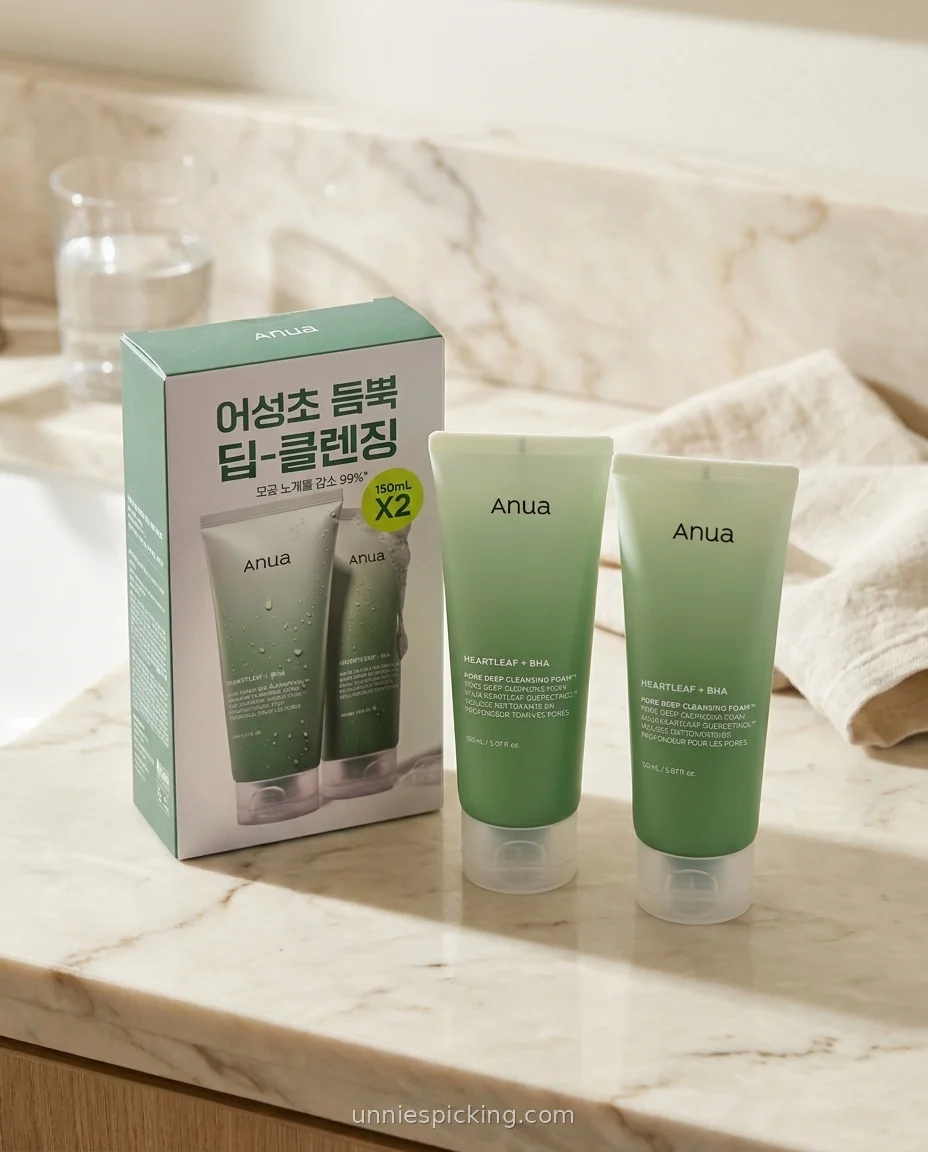
Anua Heartleaf Quercetinol Pore Deep Cleansing Foam
This is the cleanser I kept reaching for on humid Seoul mornings when my T-zone had given up on me. It is a weakly acidic foam that pairs heartleaf with a low-dose BHA, so you get a proper “nothing left sitting in my pores” clean without the tight, squeaky feeling of an old-school foaming wash. A pea-sized squeeze gives a thick, slow-popping lather, and I use it at night to take off sunscreen and the day. I picked mine up as the 150ml duo set. My full Anua Heartleaf Cleansing Foam review goes into the formula and who it will not suit.
Torriden Dive-In Cleansing Foam
If your skin is the easily-flushed, tight-after-cleansing type, this is the gentler option and the one my Korean friends named most often when I asked what they actually wash with. It is a soft white cream-paste that works into a low-density foam, rinses without a film, and has never once stung me. It is hydrating rather than pore-clearing by design, so on a heavy-sunscreen day I pair it with an oil cleanse first. It is the foam I keep repurchasing for the mornings my skin feels stripped, and I rotate it with the Anua on oilier weeks. My Torriden Dive-In Cleansing Foam review covers the full texture test.
Dr.Jart+ Cicapair Intensive Soothing Repair Serum
This is the calming step, and for spot-prone skin it matters more than people think. I use a few drops at night after toner and before moisturiser, and it is gentle enough that it has never tingled, which on my reactive skin is the whole point. A serum concentration is where centella actually does its work, pressed into clean skin before you seal it in, and it is the product I hand to anyone whose main complaint is the redness a spot leaves behind rather than the spot itself. I brought the 1+1 set home on my last trip, and the Cicapair serum on Olive Young Global is the one I would start with from the lineup. I compared all four Cicapair formats in a separate post if you are trying to choose.
Dr.Jart+ Ctrl-A Teatreement Soothing Spot
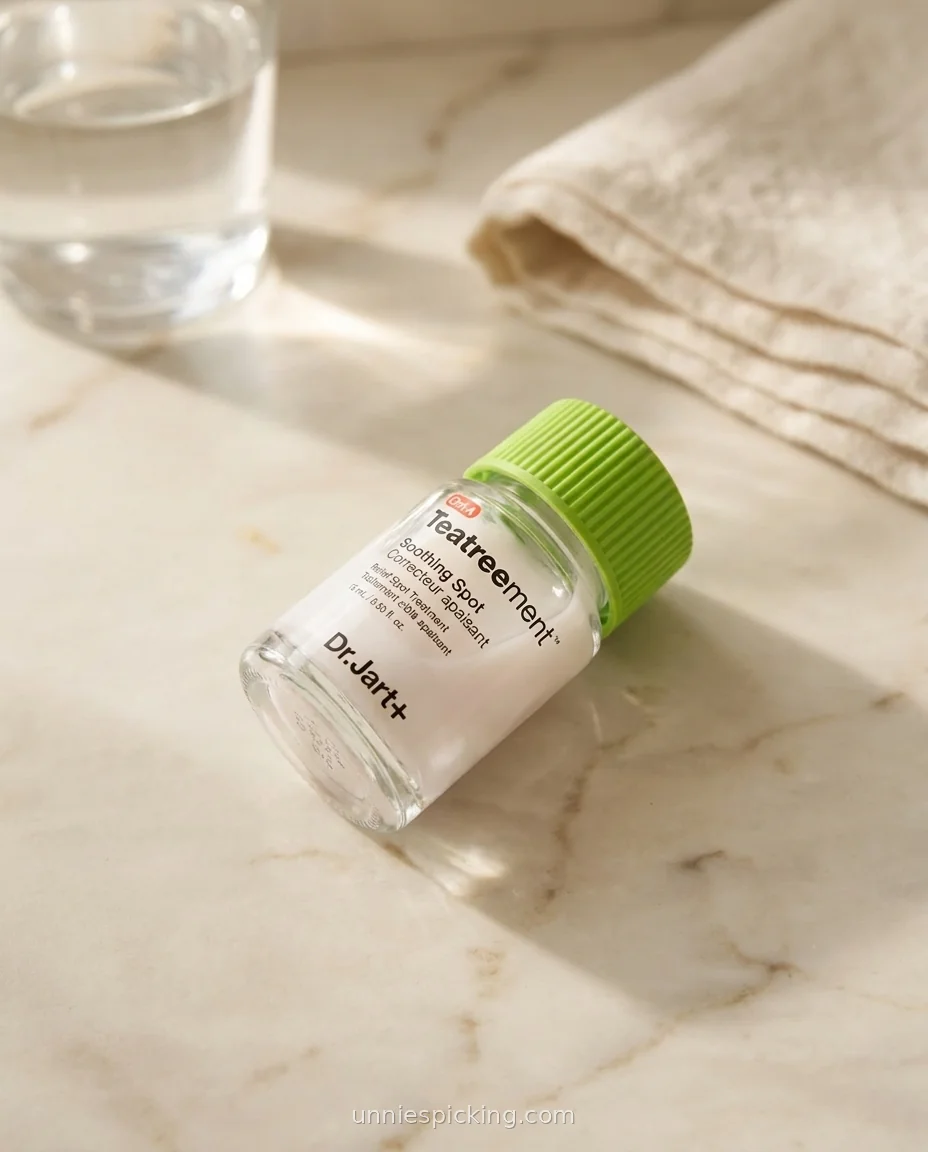
The tiny clear bottle with the lime-green cap is what I reach for when one stubborn blemish flares up before I can hide it. I picked it up at Olive Young on my last trip because I wanted a targeted tea-tree spot treatment small enough to live in my bag rather than another full-size jar on the shelf. The way I use it is simple: clean skin, a small dab straight onto the blemish, then the rest of my routine layered around it rather than over it. It calms a single angry spot without drying out the whole area, and I want to be precise about the language here: it is a soothing spot treatment, not a medicine, and I would never describe it as something that cures acne. If that is the job you need done, the Teatreement Soothing Spot on Olive Young Global is the one, and my Dr.Jart Teatreement Spot review shows it on a real blemish.
Papa Recipe Blemish Enzyme Powder Cleanser
This is the one for the weeks you want a little more than a gentle foam but do not want to reach for a scrub. It is a tea-tree enzyme powder that you activate with water in your palm, and I tested it as a daily wash specifically to see whether a powder cleanser could be gentle enough to use more than once a week. On my skin it is, as long as I keep the water-to-powder ratio generous. It leaves my skin smoother than a standard foam without the tightness. It is the Papa Recipe Blemish Enzyme Powder Cleanser, and a full Papa Recipe blemish powder cleanser review (2 October) is coming with the daily-use test.
| Product | Role in the routine | Key actives | Best for | Have I lived with it? |
|---|---|---|---|---|
| Anua Heartleaf Cleansing Foam | Night cleanse, oily weeks | Heartleaf, BHA | Combination and oily, congested T-zone | Yes, reviewed |
| Torriden Dive-In Cleansing Foam | Gentle cleanse, tight-skin mornings | Hyaluronic acid | Easily-flushed, tight-after-washing skin | Yes, reviewed |
| Dr.Jart+ Cicapair Serum | Calming step, night | Centella, madecassoside | Redness left behind by spots | Yes, reviewed |
| Dr.Jart+ Teatreement Soothing Spot | Targeted spot treatment | Tea tree | One or two occasional blemishes | Yes, reviewed |
| Papa Recipe Blemish Enzyme Powder | Gentle exfoliating cleanse | Tea tree, enzymes | Weeks you want more than a foam | Yes, daily-use test |
| SOME BY MI AHA-BHA-PHA 30 Days Miracle Toner | Exfoliating toner | AHA, BHA, PHA, tea tree | Oily skin that tolerates daily acids | No, see below |
| COSRX BHA Blackhead Power Liquid | Twice-weekly BHA treatment | 4% betaine salicylate | Blackheads and congestion | No, see below |
Two Cult Picks I Have Not Lived With
I would be leaving a hole in any Korean skincare for acne-prone skin guide if I skipped these two, because they are the products most people abroad have already heard of. I am listing them without a purchase link on purpose: I have not used either long enough to tell you honestly how my skin responds, and I am not going to borrow someone else’s thirty-day results and call them mine.
SOME BY MI AHA-BHA-PHA 30 Days Miracle Toner is the one with the famous name. It stacks three acids with tea tree in a daily toner, and it is genuinely popular with oily, congested skin that tolerates acids well. My caution is the same one I would give for any daily triple-acid product on reactive skin: patch test, start a few nights a week, and stop if your cheeks start flushing. It is worth trying if your T-zone is the main battleground and your skin is not easily irritated.
COSRX BHA Blackhead Power Liquid is the twice-a-week specialist. It is a 4% betaine salicylate liquid, which is a gentler cousin of straight salicylic acid, and people with stubborn blackheads swear by it. I would treat it as a treatment step, not a toner, and keep it away from the spot you are already calming with something else.
If either of them works for you, tell me. I would rather update this post with your experience than guess at mine.
A Calm-First Routine, Morning and Night
Here is how the shelf above turns into something you can actually do. The principle is one active at a time, soothing on both sides of it, and sunscreen every single morning because every exfoliating step on this list makes your skin more sun-sensitive.
Morning is short on purpose. A gentle cleanse, either the Torriden foam or just water if your skin feels tight, then the Cicapair serum or a hydrating toner, a light moisturiser, and sunscreen. That is it. Mornings are not the time for acids on spot-prone skin; you will spend the day flushing under your SPF.
Night is where the work happens. If you wear sunscreen or makeup, an oil or balm cleanse first, then the Anua foam to clear the pores. Pat dry. If it is an exfoliating night, this is where a BHA toner or the COSRX liquid would go, two or three nights a week at most, not the nights you are using a spot treatment. Then the Cicapair serum to calm, a dab of the Teatreement Spot on anything angry, and a moisturiser that does not feel heavy. On the nights you are not exfoliating, skip straight from cleanse to calm.
If your main problem is redness that lingers after a breakout rather than the breakout itself, the products that work for me overlap almost entirely with the soothing shelf I wrote up in my guide to Olive Young for sensitive skin. The two categories are closer than the marketing suggests.
Mistakes That Keep Spot-Prone Skin Stuck
Most of these I have made myself, which is why I can describe them so precisely.
Stacking actives. A BHA cleanser, then a BHA toner, then a tea-tree spot gel, then a “clarifying” mask on the same night. Each one is fine; together they strip the barrier and the next morning your skin is both oily and flaking. Pick one active per night.
Treating every pimple like an emergency. The instinct is to dry it out as fast as possible. On reactive skin that usually means a red, peeling patch that lasts longer than the pimple would have. A calming spot treatment plus patience is slower and better.
Skipping moisturiser because your skin is oily. Dehydrated oily skin produces more oil, not less. The lightweight gel-cream formats are exactly for this.
Skipping sunscreen because it “breaks you out”. If every SPF you have tried causes a reaction, the problem is the formula, not sunscreen as a category. Korean chemical and hybrid sunscreens are famously light, and leaving your skin unprotected after acids is how post-breakout marks turn into long-term dark spots.
Changing everything at once. If you introduce four new products in a week and your skin reacts, you have no idea which one did it. One new product at a time, a couple of weeks each.
FAQ
Is Korean skincare good for acne-prone skin?
For occasional breakouts, congestion and the redness that follows, yes, because the formulas pair gentle actives with soothing ingredients and are built to keep the skin barrier intact. For persistent or cystic acne, skincare is a support, not a treatment, and you should see a dermatologist.
What is the best Korean cleanser for acne-prone skin?
For oily, congested skin I use the Anua Heartleaf Cleansing Foam, which pairs a low-dose BHA with heartleaf and does not strip. For easily-flushed skin that feels tight after washing, the Torriden Dive-In Cleansing Foam is the gentler choice. I rotate between the two depending on the week.
Should I use a BHA toner every day for acne?
On reactive skin, no. Two or three nights a week is plenty, and never on the same night as another exfoliant or a drying spot treatment. If your skin tolerates it well you can build up, but start slow.
Do Korean acne products actually cure acne?
No, and the honest ones say so. They are cosmetics that calm, clear congestion and support the barrier. If a product promises to cure acne, be sceptical.
Can I use these if my skin is sensitive as well as spot-prone?
That is exactly my skin type, and everything in the “products from my own shelf” section was chosen for it. The two cult picks I have not lived with are the ones I would patch test first.
My Thoughts
The thing I wish someone had told me years ago is that calm skin clears faster than punished skin. Every product on my shelf for this category is there because it let me deal with a spot without starting a fight with the rest of my face, and that is the whole Korean philosophy in one sentence. Start from calm, add one active at a time, wear sunscreen, and be patient with the redness a spot leaves behind.
And be honest with yourself about where you sit on the spectrum. This post is written from skin that gets the occasional angry blemish, and I have tried hard not to dress it up as more than that. If your acne is persistent or painful, take the gentle-routine ideas here to a dermatologist rather than to a checkout.
🛍️ If you buy one thing: start with the Teatreement Spot for the blemish and the Cicapair serum for what it leaves behind. Those two have done more for my skin than any “miracle” acid.