Disclosure: This post contains affiliate links. If you purchase through these links, I may earn a small commission at no extra cost to you. I only recommend products I personally use and trust. As an Amazon Associate, I earn from qualifying purchases.
The samgyeopsal vs galbi debate comes up every single time I introduce someone to Korean BBQ. “What should I order?” Or, when cooking at home: “What should I buy?”
The honest answer is both. But if you’re starting out — limited budget, first time cooking, or just trying to understand what Korean BBQ actually is — you need to start with one. And the choice between the two is more interesting than it looks.
Table of Contents
- What Is Samgyeopsal?
- What Is Galbi?
- Key Differences at a Glance
- Full Comparison Table
- How to Cook Each One at Home
- Which One Should You Start With?
- FAQ
- My Thoughts
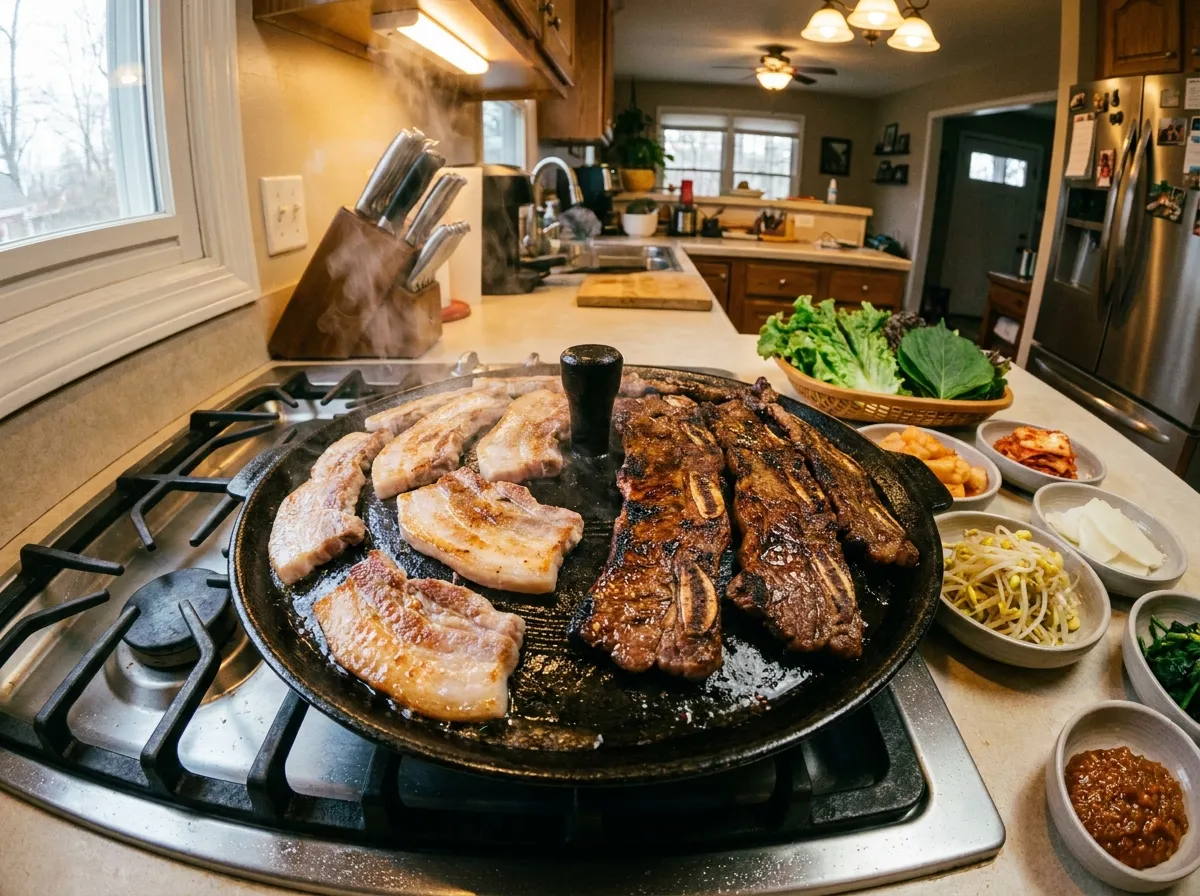
📸 Samgyeopsal and galbi side by side on a Korean BBQ grill — two cuts, two completely different experiences.
What Is Samgyeopsal?
Samgyeopsal (삼겹살) literally means “three-layer meat” — a reference to the alternating layers of fat and muscle visible in a cross-section of pork belly. It’s the same cut used for bacon, but sliced thicker and eaten fresh rather than cured. If you’re putting together your first home Korean BBQ session, our Korean BBQ at home for beginners guide covers the full setup — equipment, banchan, and how to cook both cuts from scratch.
In Korean BBQ, samgyeopsal is typically sliced about 1cm thick and cooked directly on the grill with no marinade. The fat renders as it cooks, basting the meat from within. The edges crisp up. The inside stays juicy. When it’s done right, it’s one of the most satisfying things you can eat.
Samgyeopsal is the most popular Korean BBQ cut in Korea by a significant margin. It’s cheap, widely available, and requires almost no preparation. You buy it, you slice it, you grill it. That’s the entire process.
In Sydney, you’ll find it at any Korean grocery — S Mart in Eastwood, Komart in North Strathfield, or the Korean butchers around Strathfield. Some Woolworths and Coles stores now carry pork belly too, though the Korean-style thin-sliced version is better sourced from a Korean grocer.
What Is Galbi?
Galbi (갈비) means “ribs” — specifically, beef short ribs cut in the flanken style. Each piece is sliced across the bone rather than between the bones, giving you a thin strip of meat with three small bone sections running through it.
Unlike samgyeopsal, galbi is always marinated. The classic marinade is soy sauce, Asian pear, garlic, sesame oil, sugar, and ginger. The pear contains enzymes that tenderise the tough short rib meat, and the sugar caramelises on the grill to create those glossy, slightly charred edges that make galbi so visually striking.
Galbi requires more planning than samgyeopsal. You need to marinate it for at least four hours, ideally overnight. But the result — tender, deeply flavoured beef with caramelised edges — is worth every minute of waiting.
Key Differences at a Glance
Before we get into the full comparison, here’s the short version for anyone who just wants a quick answer.
Choose samgyeopsal if: You’re cooking for the first time, you want something quick and easy, or you’re feeding a crowd on a budget.
Choose galbi if: You’re cooking for a special occasion, you have time to marinate overnight, or you want to impress guests with something that looks and tastes extraordinary.
Choose both if: You’re doing a proper Korean BBQ spread and you want the full experience.
Full Comparison Table
| Factor | Samgyeopsal (Pork Belly) | Galbi (Beef Short Ribs) |
|---|---|---|
| Meat type | Pork | Beef |
| Marinade required | No — cook as is | Yes — minimum 4 hours |
| Prep time | 5 minutes | 15 minutes + marinating |
| Cook time | 6–8 minutes total | 4–6 minutes total |
| Flavour profile | Rich, fatty, savoury | Sweet, savoury, complex |
| Texture | Crispy edges, juicy centre | Tender, slightly chewy near bone |
| Cost (per kg, Sydney) | ~$12–18 | ~$25–35 |
| Availability in Australia | Korean grocers + some supermarkets | Korean grocers (flanken cut) |
| Difficulty level | Beginner | Intermediate |
| Best occasion | Weeknights, casual gatherings | Weekends, special occasions |
How to Cook Each One at Home
Cooking Samgyeopsal
Heat your grill pan to high. No oil needed — samgyeopsal has enough fat to self-baste. Lay the slices flat on the grill and leave them alone for 3–4 minutes. Flip once. Cook another 3–4 minutes until the edges are golden and slightly crispy. Use scissors to cut into bite-sized pieces directly on the grill. Wrap in lettuce with ssamjang, raw garlic, and a sliver of green chilli. The grill pan you use has a real impact on how both cuts cook. Our guide to the best Korean BBQ grill pans for stovetop use covers which pan designs work best for samgyeopsal versus galbi.
The most common mistake: moving the meat too soon. Let it sit. The fat needs time to render and the surface needs time to develop colour. Patience is the only skill required.
Cooking Galbi
Remove from the marinade and shake off the excess — too much marinade on the grill will burn before the meat cooks. Let the meat come to room temperature for 30 minutes. Heat your grill pan to high. Cook 2–3 minutes per side, looking for caramelised, slightly charred edges. The sugar in the marinade caramelises fast, so watch it closely in the final minute.
For the best results at home, the SOGA Portable Korean BBQ Butane Gas Stove gives you the consistent high heat that galbi needs. Electric stovetops often can’t reach the temperature required for proper caramelisation.
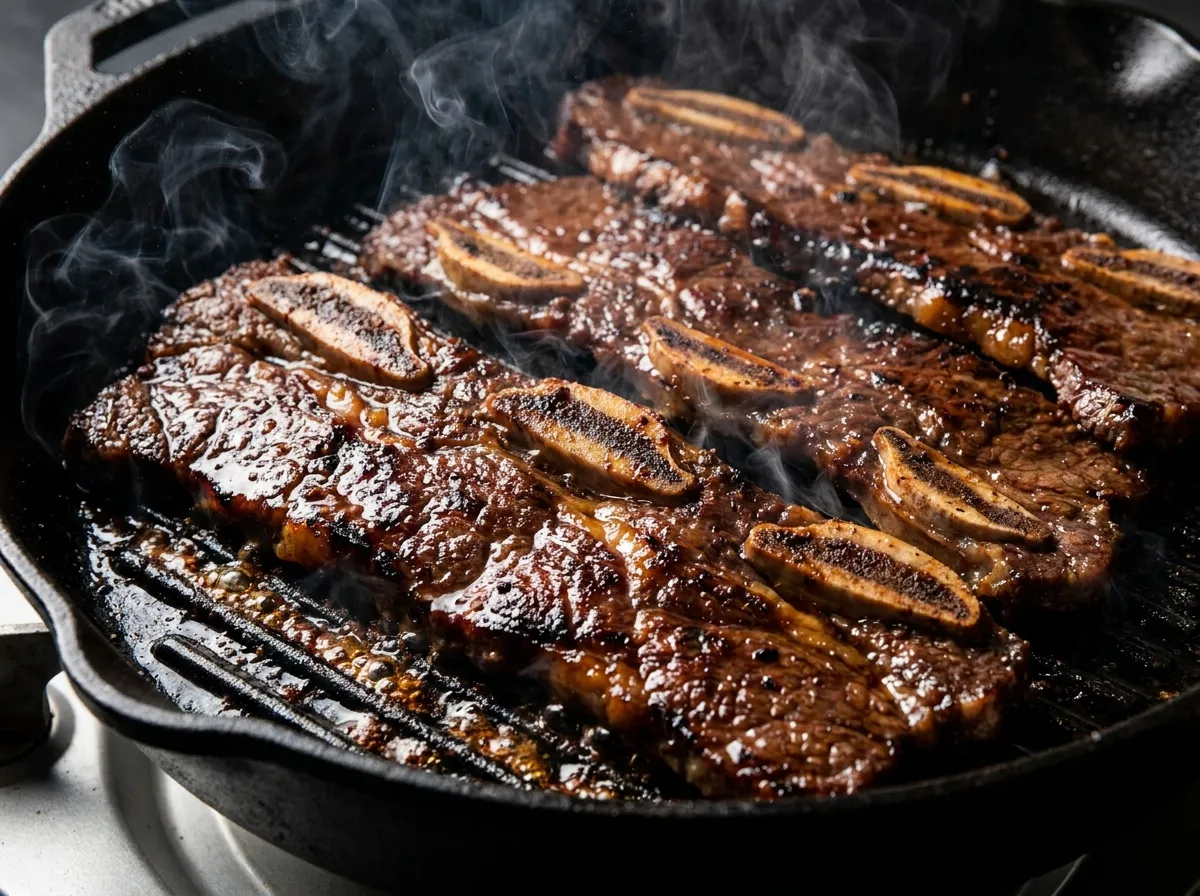
📸 Galbi caramelising on a hot grill — the glossy, slightly charred edges are the result of overnight marinating and high heat cooking.
Which One Should You Start With?
My recommendation is always samgyeopsal for your first session. Here’s why. Once you’ve committed to galbi, the marinade is the most important variable. Our step-by-step recipe for galbi marinade from scratch uses a Busan family recipe and explains exactly why each ingredient is there.
Samgyeopsal is forgiving. If your pan isn’t quite hot enough, it still tastes good. If you cook it a little too long, the extra crispiness is actually welcome. There’s no marinade to get wrong, no timing to manage, no special ingredients to source. You buy pork belly, you slice it, you grill it.
Galbi, on the other hand, rewards experience. The marinade needs to be balanced. The marinating time needs to be right. The heat needs to be high and consistent. When all of those things come together, galbi is transcendent. When one of them is off, it’s disappointing — especially given the cost of the meat.
Start with samgyeopsal. Get comfortable with the grill, the heat, and the rhythm of Korean BBQ. Then, once you feel confident, try galbi. Make the marinade from scratch. Marinate overnight. Cook it on a properly hot grill. That first bite of properly made galbi is a moment you’ll remember.
To help with the marinade, CJ bibigo Mild & Sweet Bulgogi Sauce is a reliable shortcut for your first attempt at galbi — it has the right balance of sweet and savoury and caramelises well on the grill.
FAQ
Can I cook samgyeopsal and galbi at the same time?
Yes, and it’s actually a great combination for a full Korean BBQ spread. Cook them on separate pans or in batches — they have different cooking times and the galbi marinade can burn if it drips onto the samgyeopsal. Most Korean BBQ restaurants serve both together, and the contrast between the two cuts is part of what makes the experience so satisfying.
Is galbi always beef? I’ve seen pork galbi on some menus.
Pork galbi (돼지갈비) is a thing, and it’s delicious. It’s pork ribs marinated in a similar style to beef galbi, often with a slightly spicier marinade. In Korea, pork galbi is very popular and generally cheaper than beef galbi. If you see it on a menu or at a Korean grocer, it’s worth trying.
Why is my samgyeopsal chewy instead of crispy?
Two likely causes: the pan wasn’t hot enough, or the slices are too thick. Samgyeopsal needs high heat to render the fat quickly and crisp the edges. If the pan is too cool, the fat melts slowly and the meat steams in it rather than crisping. Aim for slices about 1cm thick and make sure the pan is properly preheated before the meat goes on.
Where can I buy flanken-cut short ribs in Sydney?
S Mart in Eastwood is the most reliable source. The meat is pre-cut in the Korean style and usually available fresh or frozen. Some Korean butchers in Strathfield also carry it. If you’re outside Sydney, call ahead to your nearest Korean grocery — most can order it in if they don’t stock it regularly.
My Thoughts
I’ve been eating samgyeopsal and galbi my whole life. Samgyeopsal was the weeknight staple — quick, cheap, satisfying. Galbi was for celebrations: birthdays, Chuseok, the first day of school. My dad would start marinating it the night before, and the smell of it in the morning was the smell of something special happening.
Twenty years in Sydney, and that association hasn’t changed. When I make samgyeopsal, it’s a Tuesday night. When I make galbi, it’s a Saturday with people I love. Both are Korean BBQ. Both are essential. But they mean different things.
Start with samgyeopsal. Learn the rhythm. Then make galbi for someone worth the extra effort. That’s how I’d do it.
Ready to Start Grilling?
For your first Korean BBQ session at home, the SOGA Portable Korean BBQ Butane Gas Stove gives you the consistent high heat that both samgyeopsal and galbi need. → Check the latest price on Amazon
Related Links
If you found this article helpful, you might also enjoy these related guides:
- Korean BBQ at Home for Beginners — What I Wish I Knew Sooner — The complete beginner’s guide covering equipment, meat, marinades, and banchan.
- How to Make Galbi Marinade from Scratch (My Mum’s Busan Recipe) — Once you’re ready to try galbi, this is the marinade recipe to use.
- The Best Korean BBQ Grill Pans for Stovetop Use — Which grill pan works best for cooking both samgyeopsal and galbi at home.