Disclosure: This post contains affiliate links. If you purchase through these links, I may earn a small commission at no extra cost to you. I only recommend products I personally use and trust. As an Amazon Associate, I earn from qualifying purchases.
This Korean BBQ party guide Australia is built on hard experience — groups from four people to twenty-two. The twenty-two person one was a mistake I will never repeat. But somewhere between those extremes, I’ve figured out exactly how to throw a Korean BBQ party at home that people talk about for months afterward.
The secret isn’t the meat — though the meat matters. It’s the setup. Get the logistics right and the cooking takes care of itself. Get them wrong and you’ll spend the entire party standing over a grill while everyone else has fun without you.
Table of Contents
- Planning: How Many People, How Much Food
- Equipment for a Group
- The Party Menu
- Prep Timeline (Start Two Days Before)
- How to Set the Table
- Party Size Comparison Guide
- FAQ
- My Thoughts
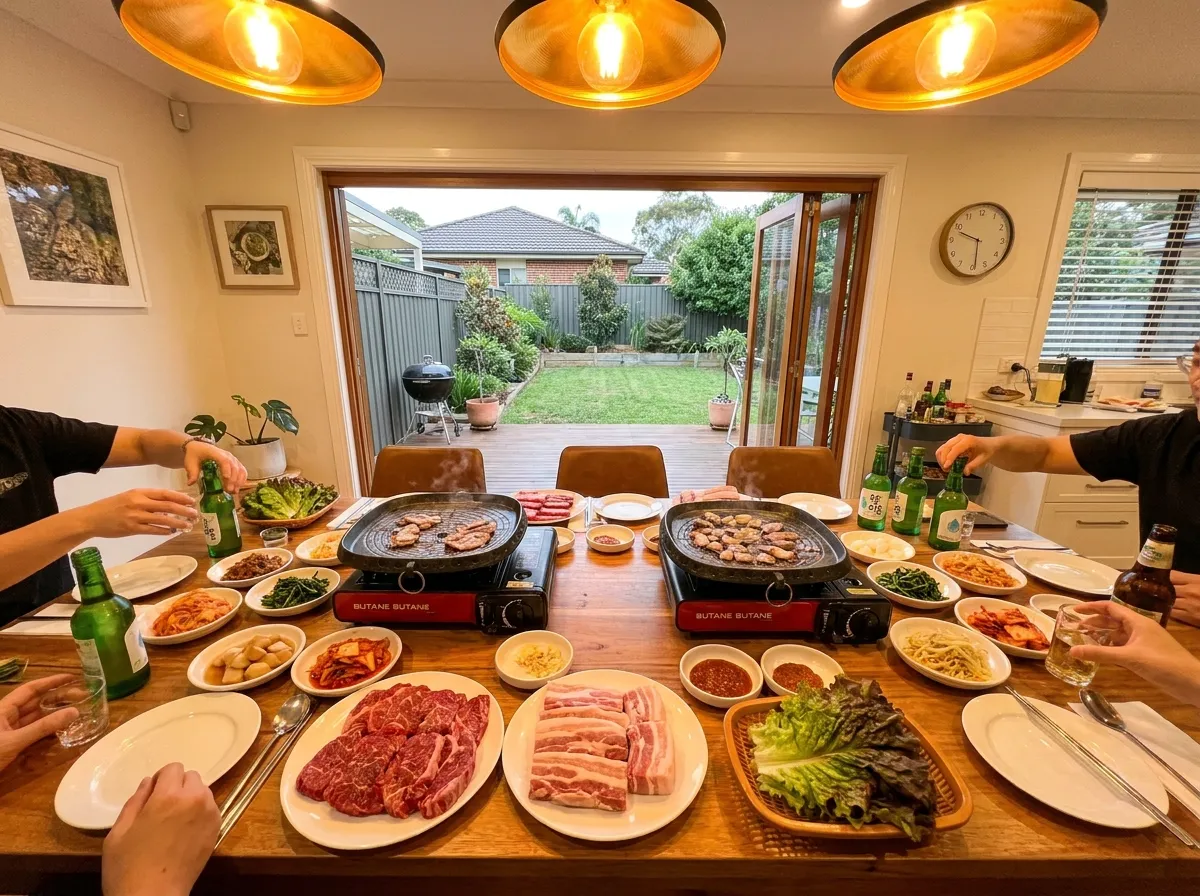
📸 A Korean BBQ party spread at home in Sydney — multiple grill pans, banchan in small bowls, and fresh ssam ingredients arranged across a large dining table.
Planning: How Many People, How Much Food
The most common mistake in Korean BBQ party planning is underestimating how much meat people eat. Korean BBQ is interactive — people cook continuously throughout the meal, and the act of cooking and eating simultaneously means consumption is higher than a standard sit-down dinner. If anyone at your party is new to Korean BBQ, it helps to have a quick reference. Our Korean BBQ at home for beginners guide is a great read beforehand — it explains the format, the meats, and how the meal flows so guests aren’t confused.
Meat Quantities Per Person
- Samgyeopsal: 200–250g per person
- Galbi: 150–200g per person
- Bulgogi: 150–200g per person
- Total meat per person: 400–500g if serving multiple cuts
For a party of eight, plan for approximately 3.5–4kg of total meat across all cuts. It sounds like a lot. It’s not.
Ideal Party Size
The sweet spot for a home Korean BBQ party is 6–10 people. This is large enough to feel like a proper gathering but small enough to manage with one or two grill setups. Beyond twelve people, you need multiple grills running simultaneously and the logistics become genuinely complicated.
Equipment for a Group
For a group of six to eight, you need at least two grill setups running simultaneously. One grill for eight people means constant queuing for food and a host who never sits down.
The Grill Setup
Two SOGA Portable Korean BBQ Butane Gas Stoves running simultaneously is my standard party setup. They’re compact enough to fit on a standard dining table without dominating the space, and having two grills means guests can cook their own meat rather than waiting for the host to manage everything.
Pair each stove with a TeChef Stovetop Korean BBQ Grill Pan for easy cleanup. At a party, the last thing you want is a high-maintenance cooking surface.
The Scissors
Every grill needs its own pair of kitchen scissors. Sharing scissors across two grills creates confusion and slows down the cooking rhythm. I use dedicated Korean BBQ Scissors and Tongs Set — stainless steel, heavy enough to cut through galbi cleanly, and easy to clean between uses.
Serving Dishes and Banchan Bowls
Korean BBQ parties live and die by the banchan spread. You need enough small bowls to serve six to eight different banchan simultaneously. Mismatched bowls are fine — in fact, they add to the homey feel. What matters is that each dish has its own bowl and there’s enough of each for everyone to help themselves freely.
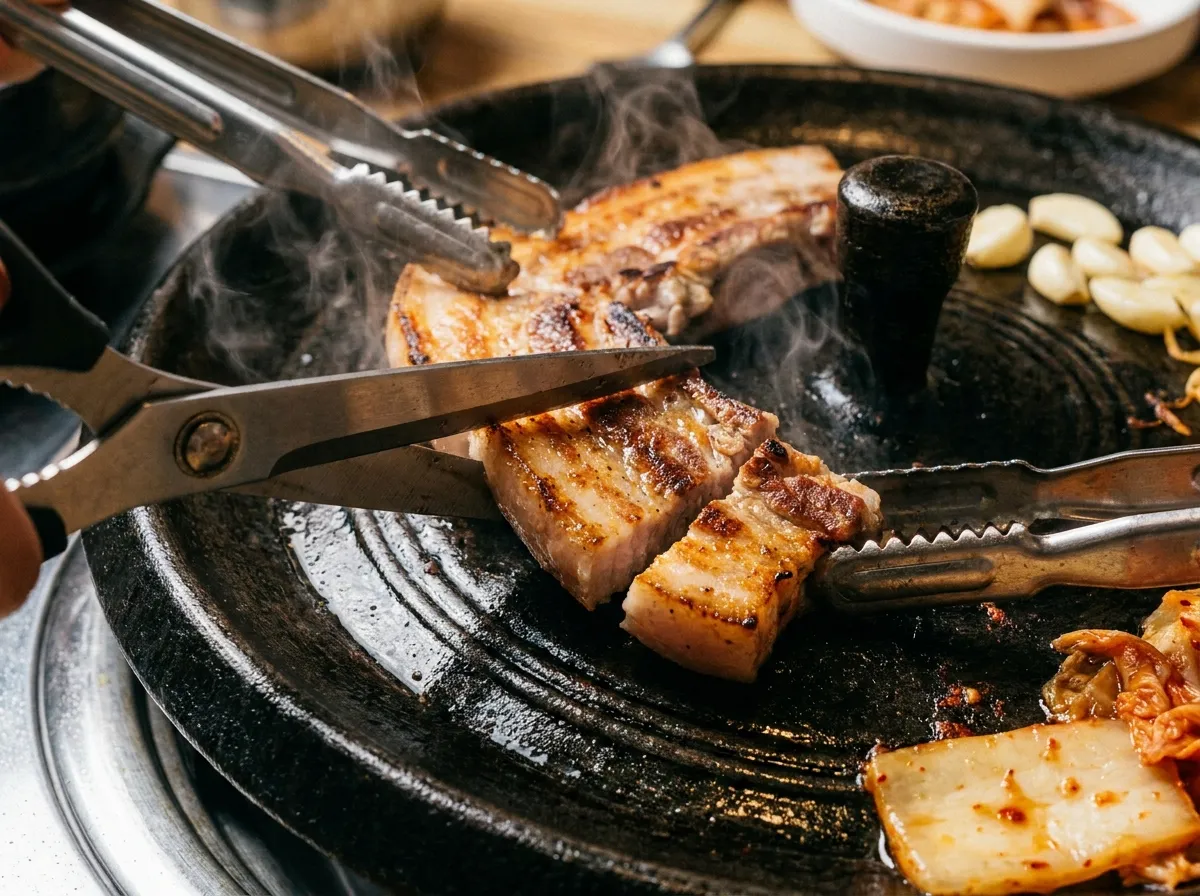
📸 Korean BBQ scissors and tongs set — the essential tools for cutting and serving grilled meat at a Korean BBQ party at home.
The Party Menu
A proper Korean BBQ party menu has three components: the grilled meats, the banchan, and the ssam (wrapping) ingredients. Here’s what I serve for a party of eight.The dipping sauce spread is what elevates a home party from basic to impressive. Our guide to Korean BBQ dipping sauces beyond ssamjang covers five options and which meats they pair with best.
Grilled Meats
- Samgyeopsal — 1.5kg, no marinade needed, cook as is
- Galbi — 1kg, marinated overnight
- Bulgogi — 800g, marinated 2–4 hours
Banchan (Make the Day Before)
- Kimchi — buy good quality from S Mart or make your own
- Kongnamul (seasoned bean sprouts)
- Spinach namul
- Pickled radish (danmuji)
- Egg custard (gyeran jjim) — make day-of, serve warm
- Japchae (glass noodles) — make day before, serve at room temperature
Ssam Ingredients
- Butter lettuce — 2 heads
- Perilla leaves (kkaennip) — 1 bunch
- Ssamjang paste — 2 small bowls, one per grill
- Raw garlic, thinly sliced
- Green chilli, thinly sliced
- Steamed rice — for guests who want it
Drinks
Soju and Korean beer (Hite or Cass) are the traditional pairing. For non-drinkers, barley tea (boricha) served cold is the authentic Korean alternative. I always have both.
Prep Timeline (Start Two Days Before)
The key to a stress-free Korean BBQ party is doing as much as possible in advance. Here’s my exact timeline.
Two Days Before
- Make japchae — it improves significantly with time
- Make or buy kimchi
- Source all meat from Korean grocer
The Day Before
- Make galbi marinade and coat the ribs — refrigerate overnight
- Make bulgogi marinade and coat the beef — refrigerate overnight
- Make kongnamul and spinach namul
- Prepare pickled radish
- Set up the table layout and check equipment
Day of Party (3 Hours Before)
- Wash and dry lettuce and perilla leaves — store in damp paper towel in the fridge
- Slice garlic and chilli
- Portion ssamjang into small bowls
- Make gyeran jjim 30 minutes before guests arrive
- Take marinated meat out of the fridge 30 minutes before cooking
How to Set the Table
The table setup is what makes a Korean BBQ party feel authentic. Here’s the layout I use. Sourcing all the ingredients in Sydney is easier than most people expect. Our guide to buying Korean BBQ ingredients in Sydney lists the best Korean grocers by suburb and what to look for when buying party quantities.
Place the two grill setups in the centre of the table, spaced so guests on both sides can reach them comfortably. Arrange the banchan bowls around the edges — one set per grill side so guests don’t have to reach across. Put the ssam ingredients (lettuce, perilla, garlic, chilli, ssamjang) in the centre between the two grills.
Raw meat goes on a plate beside each grill — not pre-cooked, not in the centre. The whole point of Korean BBQ is that guests cook their own meat. Put the raw meat within reach and let people manage their own grill.
Scissors and tongs go beside each grill. Chopsticks and small plates for each guest. That’s it. Korean BBQ tables are meant to look abundant and slightly chaotic — don’t over-style it.
Party Size Comparison Guide
| Party Size | Grills Needed | Total Meat | Banchan Dishes | Difficulty |
|---|---|---|---|---|
| 2–4 people | 1 grill | 1–2kg | 4–5 dishes | Easy |
| 6–8 people | 2 grills | 3–4kg | 6–7 dishes | Moderate |
| 10–12 people | 2–3 grills | 5–6kg | 6–8 dishes | Challenging |
| 14+ people | 3+ grills | 7kg+ | 8+ dishes | Very challenging |
FAQ
How do I keep the banchan warm during a long party?
Most banchan is served at room temperature in Korea — kimchi, namul, and pickled vegetables don’t need to be warm. The exception is gyeran jjim (egg custard), which should be served fresh and warm. Make it in individual portions in small ceramic bowls and bring it out 20–30 minutes after the party starts, when people are already eating.
What if some guests don’t eat pork?
Galbi and bulgogi are both beef, so they’re suitable for guests who don’t eat pork. For guests who don’t eat beef either, marinated mushrooms (shiitake or king oyster) and firm tofu in bulgogi marinade are excellent alternatives that cook beautifully on the grill.
How do I manage two grills at once as the host?
You don’t — that’s the point. Korean BBQ is a self-service format. Set up the grills, show guests how to use them, and then sit down and eat with everyone else. The host’s job is preparation, not performance. Once the food is on the table, the party runs itself.
Can I prepare everything the day before and just reheat on the day?
Most banchan can be made the day before and served at room temperature. The meat should not be pre-cooked — it needs to go on the grill fresh. Marinating in advance is fine and actually preferred. Pre-cooked Korean BBQ meat reheated is a completely different (and inferior) experience.
My Thoughts
The best Korean BBQ party I ever hosted was for ten people in my apartment in Newtown. We pushed two tables together, ran two grills, and cooked for four hours. Someone brought extra soju. Someone else brought their guitar. The neighbours below us knocked on the ceiling at 11pm.
That’s what a good Korean BBQ party feels like. Loud, warm, slightly chaotic, and completely memorable. The food is the vehicle — what you’re really creating is an experience that people associate with your home and your hospitality.
Plan carefully, prep in advance, and then let go of the control. Korean BBQ parties are not meant to be elegant. They’re meant to be alive.
Get Your Party Setup Ready
For a group of six to eight, two SOGA Portable Korean BBQ Butane Gas Stoves is the setup I recommend. → Check the latest price on Amazon
Related Links
If you found this article helpful, you might also enjoy these related guides:
- Korean BBQ at Home for Beginners — What I Wish I Knew Sooner — The foundation guide before you scale up to a full party.
- How to Do Korean BBQ Indoors Without Smoking Out Your House — Essential reading before running two grills simultaneously indoors.
- Where to Buy Korean BBQ Ingredients in Sydney (A Local’s Guide) — Where to source everything you need for a party-sized Korean BBQ spread.
- How to Make Galbi Marinade from Scratch — The overnight marinade that makes galbi the star of your party spread.