🌎 Table of Contents
- Introduction
- What Exactly Is a T-Money Card — and Why You Should Use It
- How to Get a T-Money Card (and Why Where You Buy It Matters)
- Loading Money: How to Top Up and Manage Your Balance
- Using T-Money in Subways, Buses, Taxis — and Tips From My Use
- Refunds & Leftover Balances: What I Learned
- Updates & Changes to Know for 2025
- Tips From My Travel That You Should Know
- Final Thoughts: Why the T-Money Card Feels Like a Local’s Secret
Introduction
When I first arrived in Seoul, the T-Money Card Korea 2025 instantly became my most essential travel companion — not just a transit card, but the key that connected me to every corner of Korea’s public transportation network. It wasn’t just a transport card — it was my key to Korea’s entire public transit network.
When I first touched down in Incheon, jet-lagged and lugging two heavy bags, I was eyeing cash, coins, and ticket machines with suspicion. Would I get stuck in line fumbling for change? Would the ticket machine accept my foreign card? That’s when I discovered the T-Money card—and in all my trips since, it’s been nothing short of magic.
The T-Money card is South Korea’s ubiquitous rechargeable transportation card. But more than that, it’s a key to moving through cities smoothly, effortlessly — no need to fuss with tickets, exact change, or language barriers. It’s what separates a stressful trip from one where you feel like you actually belong in the rhythm of the city.
Before you leave home, it’s good to understand not just how to use it, but why it works so well — and where it still has quirks that travellers should watch out for.
What Exactly Is a T-Money Card — and Why You Should Use It
The T-money card is Korea’s universal tap-and-go transit pass that locals use daily.
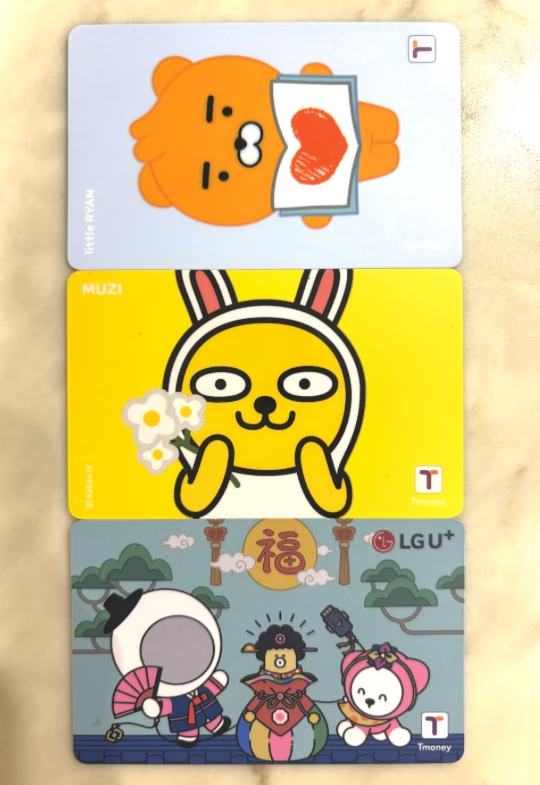
In the simplest terms, T-Money is a contactless prepaid smart card used across buses, subways, many taxis, and even in convenience stores in Korea. (It’s like combining an EZ-Pass, transit card, and small wallet all in one.)
👉 If you’re planning to use T-money for your trip, these two guides will help you get around smoothly:
🚊How to Use the Seoul Subway (2025 Guide)
🚕 Taxis in Korea: Complete 2025 Guide for Foreign Travellers
Over time, I’ve found that using a T-Money card offers three main advantages:
- Convenience: No standing in ticket lines. Just tap and go.
- Cheaper fares: Transit systems often offer slight discounts when you use a transportation card vs paying cash.
- Versatility: You can use it for convenience stores, vending machines, and certain taxis (if the terminal accepts T-Money).
Over the years, I’ve left small balances on my card intentionally, even after trips ended — the next time I come back, it’s waiting for me, ready to go.
How to Get a T-Money Card (and Why Where You Buy It Matters)
🛬 At the Airport: The most stress-free moment to get one
One of the best practices I’ve learned: get your T-Money card as soon as you land. In Incheon (or even Gimpo), there are vending machines or counters in the transit centre just beyond immigration/security.
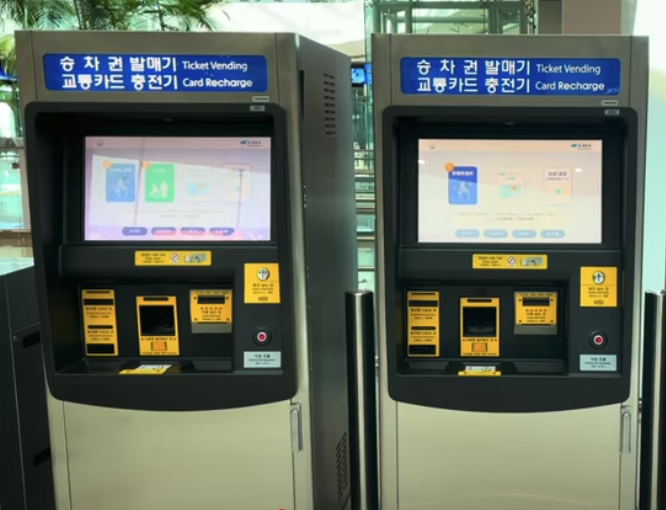
Why early? Because your very first ride (to your hotel) will be simpler — no fumbling with ticket machines, no line. Plus, you avoid waiting until later when you’re tired.
A warning, though: airport rates for the card itself are sometimes slightly higher, and you might need cash (KRW) to purchase or top up initially.
Throughout the City: Convenience stores & transit hubs
After that first card, you can easily find more in:
- Convenience stores like CU, GS25, 7-Eleven, and emart24 — these carry basic cards and sometimes fun themed versions.
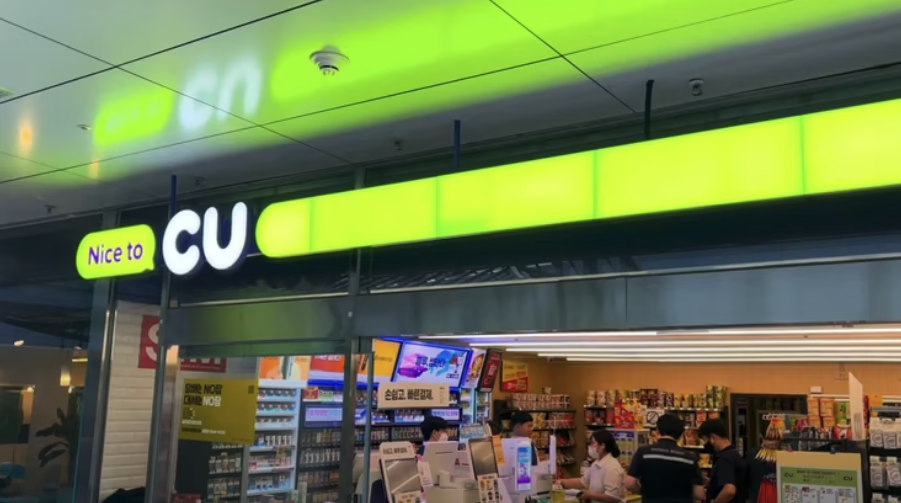
- Subway stations — ticket vending machines or customer service booths often sell and top up cards.
- Tourist information centres in areas like Myeongdong or Gangnam — occasionally, they stock them too.
When I first tried to buy in a small neighbourhood store at midnight, the clerk didn’t even ask for much — just KRW in hand, and he handed me a card. That’s how ubiquitous they are.
Loading Money: How to Top Up and Manage Your Balance
Getting and loading a T-Money card is easy, but there are small quirks to know.
🧾 Reloading steps I usually follow
- Go to a ticket vending machine at a subway station
- Select your language (English is often available)
- Tap “Recharge T-Money”
- Place your card on the pad
- Insert cash (usually in multiples of KRW 1,000)
- Confirm and wait for the update
- Use a convenience store counter
- Hand your card to the clerk, tell them how much to add, pay in cash
- They’ll top up immediately
A key tip: not all stores accept foreign credit/debit cards for reloading, so carry some KRW cash. In one instance, I had to walk three blocks because the store I tried first refused my card.
You can usually reload anywhere between KRW 1,000 up to KRW 90,000 in one go, with a maximum balance cap (often KRW 500,000) across the card.
🏙️ Checking balance & managing it
At turnstiles or bus readers, your remaining balance often appears on the display when you tap. But sometimes it’s small, so I’ve learned to make quick stops at machines or stores to verify and reload before my balance hits zero mid-ride.
Using T-Money in Subways, Buses, Taxis — and Tips From My Use
Once loaded, using T-Money is almost seamless. But from experience, here are practical things to know:
🚇 Subway trips
- Tap when entering the station, then tap again when exiting.
- The system automatically calculates the fare.
- Because many stations and lines are efficient, sometimes I forget to tap — which can lead to complications.
- If you forget to tap out, some transit staff or station offices can manually adjust it for you if you explain.
🚌 Buses (city / local buses)
- Tap once when boarding, and tap again when alighting.
- If you forget to tap off, you might be charged a default or maximum fare for that route.
- Transfers between a bus and subway often come with discounted rates if done within certain time windows (usually 30 minutes, sometimes more at night).
- At night (around 9 pm to early morning), the transfer window often extends due to sparse schedules.
🚖 Taxis & other uses
- Not all taxis accept T-Money, but many do. Look for the T-Money or 교통카드 (transport card) logo on the terminal.
- A few times I’ve hopped into a taxi and held up my card — the driver just nodded and swiped it for me.
- T-Money works in convenience stores, vending machines, and small shops — I’ve used it to buy snacks or water in stations without needing cash.
👉 Want to see how T-Money works in action?
Read: Seoul Subway Travel Guide (2025)
It explains how to navigate subway lines, transfers, and local stations step-by-step.
Refunds & Leftover Balances: What I Learned
One of the trickier parts I faced was what to do with leftover money when my trip ended.
- For balances under ~KRW 20,000, you can request a refund at many convenience stores. A small service fee (about KRW 500) is deducted.
- For larger balances, it’s often better to go to a subway station’s transit service centre.
- Note: They don’t refund the card’s original cost — you’ll only get the remaining balance after fees.
- If your balance is small and not worth the refund hassle, many travellers (myself included) simply keep the card and use it on a future trip (it doesn’t expire).
During one trip, I had about KRW 8,000 left. The clerk at the convenience store refunded it minus KRW 500. I pocketed the rest and kept the card for next time.
Updates & Changes to Know for 2025
Because Korea frequently updates systems, here’s what’s new or evolving as of 2025:
- Apple Wallet / Digital T-Money: In 2025, T-Money is adding support for Apple Wallet (Express Mode) and mobile use, but top-ups via mobile usually require a Korean bank card or ID, so foreign travellers still rely on physical reload points.
- The Korea Tour Card — once marketed for tourists — is being phased out or less emphasised; basic T-Money now handles most functionality.
- SEOL Climate Card and other local passes in Seoul are alternative options (for heavy commuters or long stays), but they often require more setup, registration, or limited usage compared to a T-Money.
- Jeju Island now accepts contactless Visa payments on some buses — but this is still limited and not reliable nationwide. T-Money still remains the more dependable transportation payment method.
Official T-money Information Center: www.t-money.co.kr
Tips From My Travel That You Should Know
- Always tap both entering and exiting on buses. That’s where money can get lost.
- Reload when your balance is comfortably above the next fare — don’t wait until it’s almost zero.
- Keep small KRW cash with you as backup — yes, I learned the hard way once when a convenience store terminal wouldn’t let me reload via card.
- If possible, keep your T-Money card after your trip (it doesn’t expire) — next time you’ll skip the “where to buy” step entirely.
- Use the internal links on your blog to other guides like Seoul Subway Guide or How to Use Korean Taxi Apps so someone reading your T-Money post can immediately jump deeper into logistics.
- For further reading on broader payments, this guide on paying in Korea (cash vs card) is very useful: “How to Pay in Korea: Cash vs Card (2025 guide)”
- Another good external resource is the Korea Navigator’s Complete T-Money Guide, which goes into refund mechanics, regional differences, etc.
Final Thoughts: Why the T-Money Card Feels Like a Local’s Secret
From the moment I tapped into Seoul’s subway or hopped onto a city bus in Busan with zero friction, the T-Money card transformed transport from chore to delight. The fewer barriers you face — language, money, ticket machines — the more you can just enjoy the city: the skyline, side streets, hidden alleys, and local cafés.
If I were to distil one piece of advice for a traveller: get your T-Money card first, use it often, and keep it for later. That small plastic card becomes your silent travel companion, smoothing your path through cities, helping you move freely without constantly pausing to solve small transactional puzzles. It’s more than just a transit card — it’s a way to travel like the city is yours for a few days.
🚄 NEXT DESTINATION:
Once you’ve mastered T-Money in Seoul, hop on the high-speed KTX to explore beyond the capital.
👉 KTX in Korea: High-Speed Rail That Changed My Travel Life
About the Author: UnniesPicking is a Korean-born writer based in Australia. She shares practical Korea travel tips and cultural insights from a global Korean’s perspective.
Related Reads
Now that you know how to use your T-Money Card, explore Seoul like a local. These guides show how easily you can reach each area by subway or bus.