🌎 Table of Contents
- From Seoul to Sydney: My Skin Shock Story
- The Science of Australian Sun (UVA vs UVB)
- Step-by-Step K-Beauty Routine for Australian Sun
- 2026 K-Beauty Innovation Ingredients to Know
- Product Comparison Table
- Expert Q&A: Top 5 Questions from Aussie Readers
- Specialist’s Secrets: The Australian Cheat Keys
1. From Seoul to Sydney: My Skin Shock Story
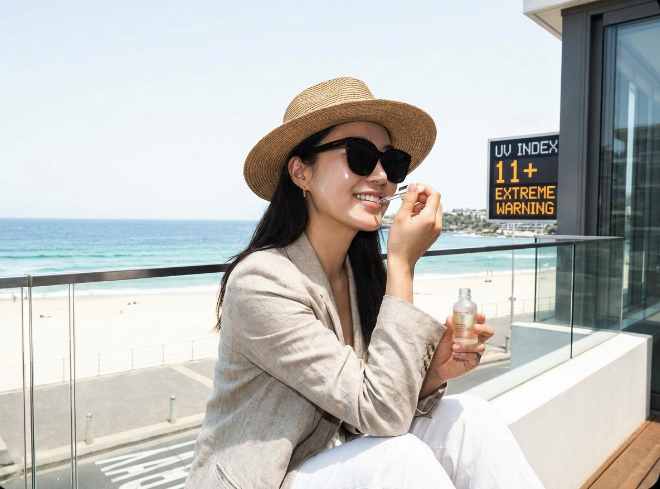
👉 Surviving UV Index 11+ at Bondi: My journey from Seoul glass skin to a climate-ready K-beauty routine for Australia. ✨(Visualized by Nano Banana 3 Flash Image)
I landed at Sydney Airport on a Tuesday in February — the most dangerous month to arrive in Australia if you have Korean skin. I was clutching my carry-on, which contained, if I’m honest, more skincare products than clothing. I had a full K-beauty arsenal: double-cleansers, essences, snail mucin ampoules, cushion compacts with SPF 50+. I was prepared. Or so I thought.
By the second week, my face had other ideas. The skin I’d spent fifteen years perfecting in Seoul — dewy, glass-smooth, barrier-intact — had developed dry patches around my cheeks, a persistent dullness no essence seemed to fix, and, most humiliatingly, a sunburn. Through my Korean SPF 50+ PA++++. In February.
A colleague laughed when I explained this. “Welcome to Bondi,” she said. She wasn’t wrong. Australia sits under one of the most aggressive UV environments on the planet, and the skin that thrives in Seoul’s temperate, humidity-rich air — where the average UV Index peaks around 6 in summer — meets a completely different adversary here. On a clear Sydney summer day, the UV Index regularly hits 11 or 12. At Bondi Beach, facing the open Pacific with no atmospheric pollution to filter incoming radiation, that number can climb to 13 or 14. In the Blue Mountains west of Sydney, the altitude strips away even more atmospheric protection.
After that first brutal summer, I went back to basics. I combined what I knew about Korean cosmetic science — probably the most advanced skincare formulation culture in the world — with what I was rapidly learning about Australian environmental dermatology. Over the next three years, I rebuilt my routine from the ground up. I tested it on myself, on my clients, on friends who dragged me to Manly Beach and Coogee. What emerged is what I’m sharing with you today.
“Korean skincare wasn’t wrong — it was simply speaking the wrong dialect. We needed to translate it into the language of Australian UV.”
This guide is for everyone who loves K-beauty but lives under the Southern Hemisphere sun. Whether you’re in Sydney, Melbourne, Brisbane, or Perth (where UV rarely dips below extreme), this is the framework that works — not just in theory, but in practice, on real skin, in 38°C humidity.
🏙️ Curious about where these trends start? Before I moved to Sydney, I spent my days exploring the heart of Seoul’s beauty scene. Check out my guide on A Day in Seongsu: Experiencing the Heartbeat of K-Beauty Culture to see where the magic happens.
2. The Science of Australian Sun: Why Your Serum Isn’t Enough
Understanding UV Radiation: UVA vs UVB
Before we talk products, we need to talk physics. Australian UV radiation is uniquely damaging for two converging reasons: the proximity to the ozone hole that drifts over the southern hemisphere in spring, and the relatively clean, unpolluted atmosphere that filters less radiation than the smoggy air over Asian megacities like Seoul, Tokyo, or Beijing. Counterintuitively, cleaner air means more dangerous sun.
UVB — The Burn Ray, 280–315nm
Causes direct DNA damage to skin cells. Responsible for sunburn and is the primary driver of squamous cell carcinoma. Peaks between 10am–2pm. SPF rating on sunscreens specifically measures UVB protection.
UVA — The Aging Ray, 315–400nm
Penetrates deeper into the dermis. Breaks down collagen and elastin. Causes hyperpigmentation, fine lines, and leathering. Present at consistent intensity all day, even on cloudy days. PA+++ ratings measure UVA protection.
Korea’s cosmetic regulatory framework — through식품의약품안전처 (MFDS) — actually mandates some of the most sophisticated PA (Protection Grade of UVA) testing in the world. This is why Korean sunscreens tend to carry PA+++ or PA++++ ratings alongside their SPF numbers, whereas many Australian or European sunscreens historically focused almost exclusively on SPF. For the Australian environment, that PA rating is not a bonus — it is essential.
The Ozone Factor: Why Seoul SPF 50 Fails in Sydney
Here’s the chemistry that burned my face in week two. The ozone column over eastern Australia is measurably thinner than over northeast Asia. The atmosphere over Sydney absorbs approximately 10–15% less UV radiation than the atmosphere over Seoul at the same latitude equivalent. A Korean SPF 50 formulation — rigorously tested and certified — was simply not engineered for this environment. It protects against the UV load that Korean regulators anticipated. Add Australian atmospheric conditions, subtract Seoul’s pollution-scattering effect, and you have a meaningful gap in protection.
This doesn’t mean Korean sunscreens are inferior. It means they need to be applied differently here: more generously, more frequently, and — critically — layered beneath additional physical protection strategies.
Sydney’s Microclimate Extremes
Sydney is not one climate. Bondi Beach and the Eastern Suburbs bake in reflected UV from the water and white sand — both intensify radiation exposure significantly. The inner-city suburb of Newtown, ringed by terrace houses, provides far more shade. Parramatta in western Sydney experiences higher temperatures with lower humidity — brutal for barrier function. And the Blue Mountains, while cooler, sit at altitudes where UV intensity increases roughly 4% per 300 metres of elevation. Your routine may actually need to shift depending on which Sydney you’re navigating on any given day.
3. The K-Beauty Routine for Australian Sun: Step by Step
The architecture of this routine follows three interlocking pillars: Protection, Hydration, and Recovery. Each step has a specific rationale — I’ll explain the why as well as the what, because understanding the logic makes you a better judge of your own skin’s needs.
Morning Routine: Protection Phase
Step 1: Gentle Cleanse – Low-pH gel or foam cleanser (pH 4.5–5.5). Avoid stripping sulfates — you’re preparing the skin to absorb, not starting a battle.
Step 2: Hydrating Toner / Essence – Fermented essence or hyaluronic acid toner to prime skin. Pat, don’t rub. This seals moisture before the barrier is challenged by the day.
Step 3: Barrier Serum Ceramide + niacinamide serum. Australian conditions destroy the lipid layer. Ceramides are non-negotiable.
Step 4: Lightweight Moisturizer – Gel-cream in summer, richer emulsion in cooler months. Creates the film for sunscreen to adhere to.
Step 5: SPF 50+ PA++++ Sunscreen – The non-negotiable MVP. Korean hybrid chemical/physical formulas offer the best cosmetic elegance with serious protection. Apply generously — ¼ teaspoon for the face.
‼️ A critical note on sunscreen quantity: most people apply 20–50% of the amount needed to achieve the labeled SPF. The standard test uses 2mg/cm² of skin surface. For an average adult face and neck, this is approximately 1.5–2ml — about ¼ teaspoon. I know it feels like a lot. Apply it anyway.
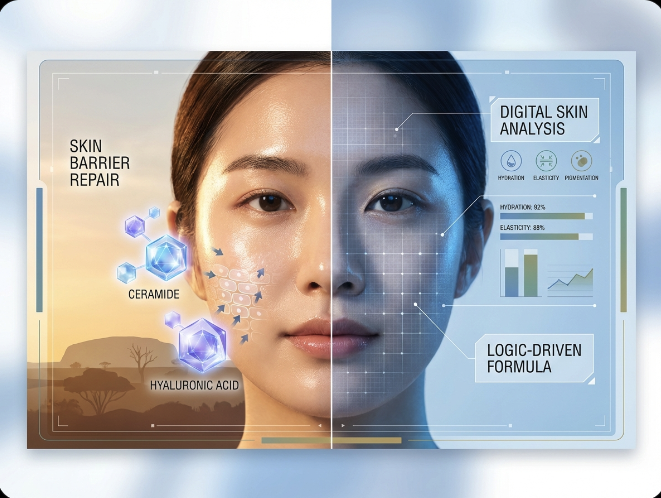
👉 Is your skin barrier actually protected? 🧪 Don’t waste money guessing — get a personalized diagnosis for your best K-beauty routine for Australia today. (Visualized by Nano Banana 3 Flash Image)
‼️ Expert Warning
Wearing the wrong moisturiser or sunscreen for your skin type creates a false sense of protection while potentially worsening your skin barrier. Heavy oils in a humid Sydney summer can trigger comedones. Alcohol-heavy toners in dry inland climates will shred your barrier further. Products chosen for someone else’s skin type are not neutral — they can actively harm yours. If you’re unsure where you sit on the skin type spectrum, a personalized diagnosis will change how you spend your skincare budget. Visit https://kbeautify.unniespicking.com — it takes 8 minutes and might save you months of frustration.
✈️ Planning a trip to Korea soon? If you’re heading to Seoul to stock up on these essentials, don’t miss our Myeongdong Travel Guide: Best Shopping & Street Food in Seoul. It’s the ultimate map for any K-beauty lover!
Midday Reapplication: The Step Most People Skip
Sunscreen degrades in UV light. After 2–3 hours of outdoor exposure, your SPF coverage is substantially diminished. In Korea, reapplication was something you did at the park. In Sydney, it’s something you do before you go to collect your coffee from the café across the road.
The Korean cosmetics industry has partially solved this problem with cushion compacts and SPF mists — product formats that allow reapplication over makeup without requiring a full reapplication process. A cushion compact with SPF 50+ PA++++ pressed gently over makeup is a legitimate and effective reapplication method, validated by clinical studies. Keep one in your bag. Use it.
Evening Routine: Recovery Phase
Step 1 Oil Cleanser – Dissolves sunscreen (especially water-resistant formulas). Non-negotiable after SPF. Emulsifies without disturbing pH.
Step 2 Water-Based Cleanser – The second cleanse removes remaining emulsified debris. Keep it gentle — your evening routine is about recovery, not stripping.
Step 3 Exfoliant (2–3x/week) – Low-concentration PHA or gentle BHA. PHAs (polyhydroxy acids) are gentler than AHAs and less likely to sensitise UV-stressed skin.
Step 4 Treatment Essence – Galactomyces ferment filtrate, bifida ferment lysate — these fermented actives repair while the skin is in overnight regeneration mode.
Step 5 Recovery Ampoule – PDRN, centella asiatica, or peptide-based. This is your heavy artillery for days when Bondi did its worst.
Step 6 Barrier Cream / Sleeping Mask – Occlusive layer seals everything in. On high-UV days, add a sheet mask first for intensive repair.
Weekly Treatments: The Recovery Rituals
Every Sunday evening — what I call my 피부 회복의 날 (skin recovery day) — I dedicate 40 minutes to intensive treatment. This mirrors the Korean practice of regular professional-grade home care: a deep-hydrating sheet mask (left on for 20 minutes), followed by a centella asiatica gel pack, finished with a rich sleeping mask. It sounds indulgent. In the context of what Australian UV does to skin across a week, it’s basic maintenance.
4. 2026 K-Beauty Innovation Ingredients
PDRN (Polydeoxyribonucleotide) — The Salmon DNA Miracle
PDRN has been used in Korean aesthetic medicine for over a decade, primarily in injectable treatments. In 2024–2025, K-beauty formulation teams cracked the delivery problem, creating topical PDRN molecules small enough to penetrate the stratum corneum without injections. The mechanism is genuinely impressive: PDRN stimulates purinergic receptors (specifically A2A receptors) in fibroblasts, triggering growth factor production and collagen synthesis. For UV-damaged skin, where fibroblast activity is suppressed and collagen degradation is accelerated, PDRN ampoules offer a measurable recovery pathway.
Caveat: Topical PDRN penetration is still limited compared to mesotherapy. Claims of “injection-like results at home” are marketing hyperbole. What you’re getting is genuine anti-inflammatory benefit and some collagen support — meaningful, but not surgical. Also, as with any biologically derived ingredient, allergy sensitivity (particularly for those with seafood allergies) should be assessed before use.
PDRNAnti-inflammatoryCollagen supportFibroblast activation
Spicule (Freshwater Sponge Spicule) — The Micro-Needling Mimic
This is the ingredient I recommend most often to clients who want accelerated skin renewal without professional procedures. Spicule — derived from freshwater sponges — consists of microscopic silica rods that create controlled micro-channels in the skin surface on application. These micro-channels temporarily enhance the absorption of subsequent active ingredients by 300–400% according to independent in vitro studies. The tingling sensation on application is real and expected.
Cons worth noting: Spicule treatment is not suitable for compromised or sensitized skin. After a heavy UV day, when your barrier is already stressed, spicule use can cross from stimulating to irritating. I recommend it only on recovery days (typically 48+ hours after significant sun exposure) and never in combination with strong exfoliants. Also, the market is flooded with underdosed spicule products — effective concentrations start around 3%.
Freshwater spiculeMicro-channel deliveryEnhanced absorptionCell turnover
Bakuchiol — The Retinol Alternative for Sun-Sensitive Skin
Retinol and Australian sun are an uncomfortable marriage. Retinol increases photosensitivity, which in a UV Index 11 environment requires rigorous sun protection compliance that even dedicated skincare people sometimes fail to maintain. Bakuchiol, a plant-derived alternative from the Psoralea corylifolia plant, demonstrates comparable collagen-stimulating and anti-wrinkle efficacy to retinol in published clinical trials, without the photosensitizing effect. For Australians serious about anti-ageing, bakuchiol is often the more pragmatic active.
BakuchiolRetinol alternativeCollagen stimulationPhotosafe
Centella Asiatica Complex — The Barrier Restoration Workhorse
Cica (Centella Asiatica) is not new — it’s been a Korean skincare staple for decades. What’s new in 2026 is the sophistication of the extraction process: standardized asiaticoside concentrations, combined with madecassoside and asiatic acid fractions, now allow formulators to create what are essentially pharmaceutical-grade topical anti-inflammatory preparations in consumer packaging. For UV-stressed, barrier-compromised skin, a well-formulated Cica cream is the single most effective immediate recovery tool I know.
Centella asiaticaMadecassosideBarrier repairAnti-inflammatory
Galactomyces Ferment Filtrate — The Fermentation Icon
Korea’s obsession with fermented ingredients is not aesthetic preference — it’s microbiology. Galactomyces ferment filtrate (the key active in many iconic Korean essences) has a molecular profile of nutrients, amino acids, and organic acids that improves skin texture, reduces sebum overproduction, and enhances barrier function. Crucially, it also demonstrates gentle brightening effects that counter the hyperpigmentation Australian UV aggressively triggers.
🛒 Looking for more top-rated picks? If you want to see what else is trending right now, browse our list of the Top 10 Korean Beauty Products Australians Love in 2026.
📦 Running a beauty business in Australia? For those looking to buy in bulk, I’ve vetted the Top K-Beauty Wholesale Supply Sites for 2026 to help you source authentic products safely.
5. Product Comparison Table
| Product | Key Actives | AU Climate Fit | Price (AUD) | Cons | Expert Rating |
|---|---|---|---|---|---|
| ISNTREE Hyaluronic Acid Watery Sun Gel SPF 50+ PA++++ | HA, Niacinamide, Panthenol | Excellent | ~$28 | May pill under heavy makeup; less water-resistant for beach use | ★★★★★ 4.8/5 |
| Beauty of Joseon Relief Sun: Rice + Probiotics SPF 50+ PA++++ | Rice Bran, Probiotics, Niacinamide | Excellent | ~$25 | Slight white cast on deeper skin tones; not ideal for oily skin in high humidity | ★★★★★ 4.7/5 |
| Dr. Jart+ Cicapair Tiger Grass Cream | Centella Asiatica, Madecassoside | Excellent | ~$65 | Premium price point; colour correction may look heavy if overapplied | ★★★★★ 4.6/5 |
| COSRX Advanced Snail 96 Mucin Power Essence | Snail Secretion Filtrate 96% | Good | ~$30 | Not a standalone barrier repair; texture may feel sticky in humid conditions | ★★★★ 4.4/5 |
| Missha Time Revolution The First Treatment Essence | Galactomyces Ferment Filtrate 70% | Good | ~$55 | High ferment concentration can cause sensitivity in very reactive skin; lower immediate hydration vs HA-based essences | ★★★★ 4.3/5 |
| Skin1004 Madagascar Centella Ampoule | Centella Asiatica 100%, Asiaticoside | Excellent | ~$22 | Very minimal formulation — not suitable as sole recovery product; limited moisturisation | ★★★★★ 4.7/5 |
| By Wishtrend Pure Vitamin C 21.5% Advanced Serum | Vitamin C 21.5%, Ferulic Acid | Use with caution | ~$40 | Very minimal formulation — not suitable as sole recovery product; limited moisturization | ★★★★ 4.2/5 |
Wait — Is Your Routine Right for Your Skin?
Spending hundreds of dollars on products that don’t match your skin type is not a skincare routine — it’s an expensive experiment. Before you add anything from this table to your cart, spend 8 minutes on a proper personalized diagnosis. Your skin will be very grateful.
🚀 Ready for a Routine Built Around Your Actual Skin?
Skip the trial-and-error. Get a personalized K-beauty protocol calibrated for your skin type, your Australian climate zone, and your lifestyle.
👉 ✨ Start My Free Diagnosis & Get My Glow Back → 🇦🇺 Trusted by Aussies. 100% Free Analysis.
6. Expert Q&A: Top 5 Questions from Aussie Readers
🙋🏻♀️ My Korean skincare makes me break out in the summer. Is it too heavy for Australian humidity?
Almost certainly, yes — but the specific culprit matters. Emollient-heavy creams designed for the dry, heated-indoor winters of Seoul contain occlusive ingredients (petrolatum, shea butter fractions, heavy plant oils) that are brilliant in dry, cold, and suffocating in Sydney humidity. Audit your moisturizer and barrier cream first. Switch to water-gel textures in summer, reserve the richer formulas for winter. Also, check your essence — fermented essences are generally fine, but some contain glycols that can be comedogenic in a humid environment.
🙋🏻♀️ Is Korean sunscreen actually sufficient for Australian UV levels, or do I need an Australian-certified one?
Korean sunscreens certified at SPF 50+ PA++++ are formulated to rigorous standards and are generally excellent. The PA++++ rating means the UVA protection factor is ≥16, which is superior to many products certified only to Australian AS/NZS 2604 standards, which don’t mandate specific UVA ratings. However, two practical factors favor Australian formulas: they are often tested under conditions calibrated to Southern Hemisphere UV intensities, and they are more likely to include water-resistant formulation — important for beach, sport, or high-sweat environments. My recommendation: Korean SPF for daily city life; consider layering with an Australian-certified sunscreen for beach days at Bondi or Coogee.
🙋🏻♀️ I have dry skin. Won’t the Australian heat just make it worse?
Sydney’s coastal humidity actually helps dry skin types compared to Seoul’s winter or inland Australia. The challenge is specifically UV-induced barrier disruption — when UV radiation damages the ceramide-lipid matrix of the stratum corneum, trans-epidermal water loss accelerates regardless of ambient humidity. The answer for dry skin is not more moisture — it’s barrier repair first. Prioritize ceramide serums and occlusives in your routine before layering humectants. Once the barrier is intact, your skin will retain what you give it.
🙋🏻♀️ How do I layer SPF correctly with my makeup?
The framework is: skincare → sunscreen → makeup. Sunscreen should be the last skincare step and the first step of any coverage-based product application. Let your sunscreen fully set for 2–3 minutes before applying foundation. In terms of reapplication, a cushion compact with SPF 50+ PA++++, pressed over makeup, is a validated and effective method — patting, not dragging, preserves your base. If you use a setting spray, apply it before your SPF cushion reapplication. A dedicated SPF setting mist is also an option, though I find cushion compacts more reliable for achieving the necessary application density.
🙋🏻♀️ Is the 10-step K-beauty routine realistic for a busy Aussie lifestyle?
Not always, and that’s fine. The “10-step routine” was never meant to be a daily mandatory protocol — it was a comprehensive framework from which you select what your skin needs. My minimum-viable routine for Australian conditions: low-pH cleanser, ceramide serum, and SPF 50+ PA++++ sunscreen in the morning; oil cleanser, water cleanser, and a recovery serum in the evening. That’s six steps total, and takes under 10 minutes morning and night. Everything else is optimization. The absolute non-negotiable — the one I will argue for with the conviction of someone who got sunburnt through SPF 50 at Bondi — is the sunscreen. That one step, done correctly, is worth more than all the ampoules combined.
7. Specialist’s Secrets: The Australian Cheat Keys
What I Tell My Private Clients (Now Telling You)
1 Store your fermented essences and PDRN ampoules in the refrigerator. This extends active longevity, and the cooling application effect is immediately soothing on heat-stressed Sydney skin. The cold also briefly constricts capillaries, reducing the redness that Australian UV reliably triggers.
2. The Blue Mountains effect: when hiking or spending extended time at altitude, apply 30% more sunscreen than you think you need and reapply every 90 minutes, not 120. At 1,000m elevation, UV intensity is approximately 13% higher than at sea level. I learned this the hard way near Katoomba.
3 Use a sheet mask after any beach day — even if you don’t feel sunburnt. UV exposure triggers inflammatory cascades that manifest 12–24 hours post-exposure. A centella-infused sheet mask applied evening after a Bondi or Manly visit intercepts this inflammatory response before it fully develops. Think of it as the skincare equivalent of icing a muscle before it swells.
4 On days when the BOM UV Alert says “Extreme” (UV 11+), skip your exfoliation step entirely — even your gentle PHA. Exfoliation on UV-stressed skin accelerates trans-epidermal water loss and reduces your skin’s already-compromised ability to recover. Recovery must come before renewal.
5 The Westfield test: shopping center fluorescent lighting and air conditioning are secretly very drying. Sydney’s indoor climate in summer is heavily air-conditioned to brutal levels — the air inside a Pitt Street Mall store can be drier than a Seoul winter. Keep a facial mist in your bag for indoor hydration top-ups. It sounds fussy until your skin stops flaking by 3 pm.
⚠️ Final Expert Reminder
The most common mistake I see is people building routines based on what worked for someone with different skin, in a different city, with a different lifestyle. Skin is biographical — it remembers every Bondi summer, every air-conditioned office winter, every sleep-deprived month. A routine that solves someone else’s skin problems is not your routine. Before investing in a full protocol, take 8 minutes for a personalized assessment at beautify.unniespicking.com. Your skin type, barrier condition, and environmental exposure profile all change how even the best products perform. What I use is my data. What you need is yours.
Ready for a Routine Built Around Your Actual Skin?
Skip the trial-and-error. Get a personalized K-beauty protocol calibrated for your skin type, your Australian climate zone, and your lifestyle.
🛑 Stop Guessing Your Skincare!
Using the wrong products in the Australian sun can do more harm than good. Don’t waste your budget on a routine that wasn’t built for your unique skin barrier.
👉 ✨ Start My Free K-Beauty Diagnosis → Takes only 8 minutes. Get your climate-ready routine now.