Disclosure: This post contains affiliate links. If you purchase through these links, I may earn a commission at no extra cost to you.
If you are looking for the Incheon Airport Limousine Bus to Seoul 2026, this updated guide provides everything you need to know, from the latest fares (17,000–18,000 KRW) to revised schedules and my personal ride review.
🌎 Table of Contents (2026 Updated)
- Introduction — A Different Kind of Arrival
- Why I Chose the Limousine Bus This Time
- How to Take the Limousine Bus (2026 Updated)
- What the Ride Really Feels Like — My Real Experience
- Comparison: Bus vs AREX vs Taxi (2026)
- Korean vs Australian Transportation — A Cultural Reflection
- Helpful Tips Only a Long-Term Expat Notices
- FAQs (2026 Updated)
- Final Thoughts — What This Ride Means to Me Now
- Related Reads (Recommended for Your Seoul Trip)
Introduction — A Different Kind of Arrival
If you’re looking for the most reliable Incheon Airport Limousine Bus to Seoul 2026, here’s my updated guide based on my real ride experience
There is a moment at Incheon Airport that I’ve grown to love—not the familiar sliding doors or the smell of coffee drifting from the arrivals hall, but the quiet pause that happens before you choose how to enter the city. After living in Australia for so many years, my sense of “arrival” has changed. Landing doesn’t feel like the end of a journey anymore; it feels like the beginning of a slow return, a readjustment of rhythm.
On this particular trip, instead of heading straight to the taxi stand like I often did in my younger years, I found myself pulled toward something gentler: the Incheon Airport Limousine Bus. Maybe it was the soft evening light through the glass panels, or maybe it was the way the buses glide in and out—measured, dependable, gracious in their slowness.
This guide is part travel story, part practical information, and part cultural reflection. If you want a smooth, comfortable ride from Incheon Airport to Seoul in 2026, the limousine bus may surprise you with how calming, scenic, and thoughtful the experience is.
But today, let’s slow down and take the bus together.
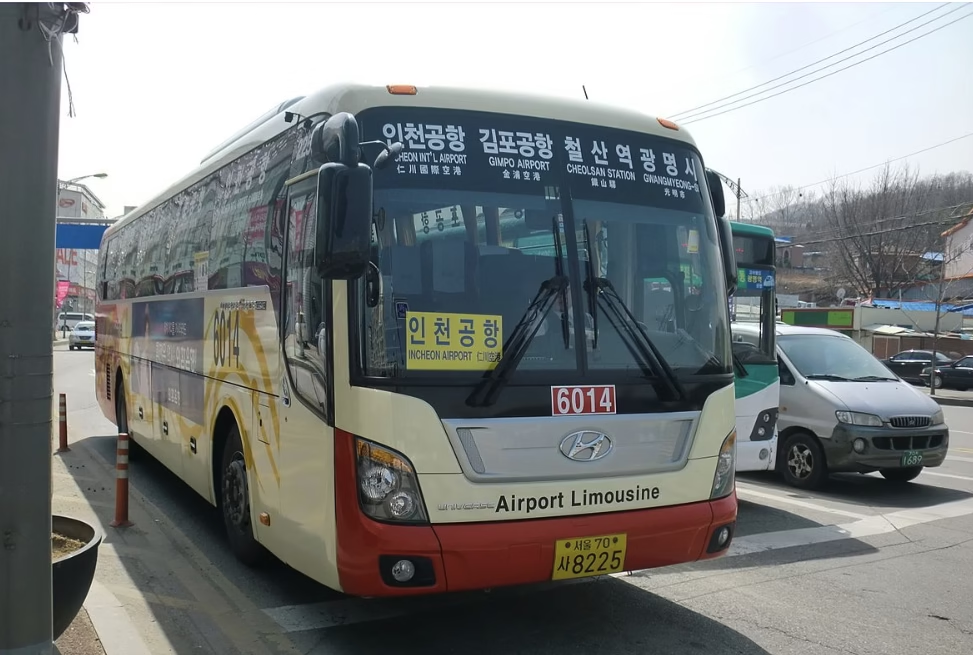
☝️ Route 6014 Airport Limousine Bus heading toward Incheon Airport, photographed near a local bus stop on a clear day (Image source: Wikipedia.org)
Why I Chose the Limousine Bus This Time
I had just stepped off a ten-hour flight from Sydney. My legs felt heavy, and even the bright efficiency of Incheon Airport felt overwhelming in that familiar “too many lights after too many hours in the sky” way. I needed something unhurried—something that wouldn’t require me to navigate escalators, platforms, or ticket gates.
👉 The Best Food Markets in Seoul – A 2026 Guide picks up exactly on this — seoul is a city that never sleeps, and at its heart are the best food markets in seoul — places where tradition, culture, and it goes from there.
The limousine bus felt like an invitation to breathe.
🚐 Traveling in a Group? While the bus is great, if you have 3+ people or lots of luggage, a Private Airport Transfer might be more cost-effective and takes you directly to your hotel doorstep.
What I appreciate most about Korea’s airport buses—especially after living in Australia—is how they strike a balance between precision and warmth.
- Australian transport is reliable but relaxed.
- Korean transport is reliable but intentional.
The bus captures this difference perfectly. Thick seats, dim interior lights, luggage handled for you, and a panoramic view of the city as it wakes or sleeps.
It’s not just a bus; it’s a transition space. A buffer between the intensity of travel and the energy of Seoul.
How to Take the Limousine Bus (2026 Updated, Simple & Clear)
1. Buying Tickets — Three Easy Options
Unlike the AREX or subway, the limousine bus gives you several convenient ways to pay:
A. Ticket Counters (easiest for first-timers)
🎫 Skip the Kiosk Lines: You can pre-book your ticket and just show a QR code when boarding. It’s faster and ensures you don’t fumble with cash. Book Your Discounted Bus Ticket Here
Located near exits 4, 6, 7, 8, 9, 11, and 13 on the 1st floor.
Cards and cash accepted.
B. Ticket Machines
Fast, touch-based, English-friendly, and accepts Visa/Mastercard/Wise.
C. Pay-on-Board
Available on certain routes—tap T-money or pay by card.
2. Fares (2026)
- Standard Limousine: ₩12,000–₩16,000
- Deluxe / Premium: ₩17,000–₩19,000
- Night Routes: +₩1,000–₩2,000
When I compare this to Sydney, where a simple airport train can cost AUD $20–25, it still amazes me how Korea keeps high-quality transport affordable.
3. Popular Routes
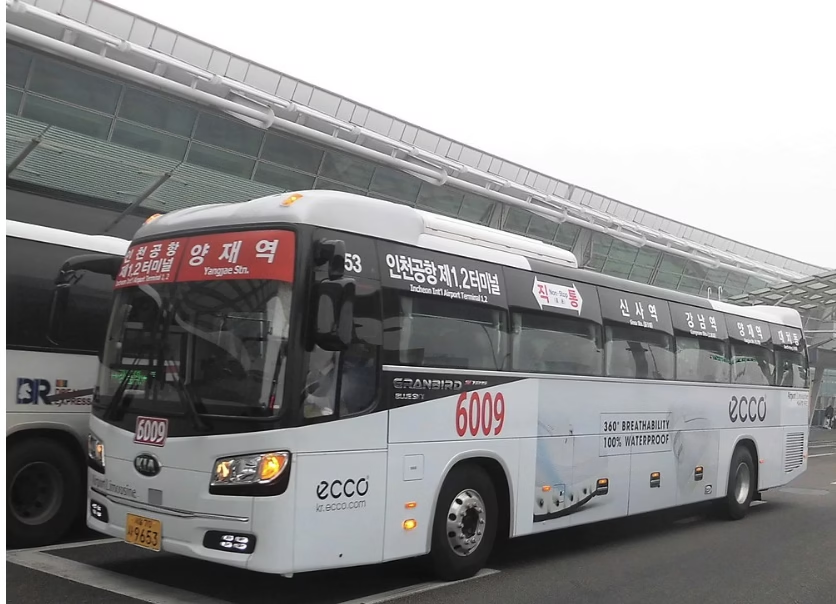
☝️Route 6009 Airport Limousine Bus operating between Seoul and Incheon Airport, photographed near Terminal 1 (Image Source: Wikipedia.org)
You don’t have to memorise numbers—just know the key destinations:
- Myeongdong → Bus 6001 / 6015
- Gangnam → Bus 6009 / 6703
- Hongdae → Bus 6002
- Seoul Station → KAL Limousine
These cover most tourist hotels and major districts.
If you’re heading into the city and want deeper neighbourhood guides, check these next:
👉 Hongdae Travel Guide 2026 – Cafés, Streets, Nightlife & Shopping
A full local-style walkthrough of the area, perfect after taking Bus 6002 from Incheon Airport.
👉 Myeongdong Shopping Guide 2026– Best Stores, Food Streets & Hidden Spots
Ideal if you’re taking Bus 6001 or 6015 — this guide shows you exactly where to shop, eat, and explore.
4. Travel Time
Expect 60–80 minutes, depending on traffic and whether you catch a peak-hour bus.
5. Timetable (Most routes)
Every 15–25 minutes from early morning to late at night.
Official schedule:
What the Ride Really Feels Like — A Different Experience from Taxis & AREX
Instead of describing the view from Incheon Bridge (which I wrote about in my taxi guide), let me tell you a different story—one that shaped how I now see this bus ride.
A Quiet, Almost Cinematic Hour
It was late afternoon when I boarded. The sun hadn’t fully set, but the sky was turning a soft gold—the kind of light Sydney sometimes gets in winter, but cooler, almost silvery. I sat near the window, and as the bus pulled away, the terminal slowly disappeared behind us.
There was a young family sitting across the aisle. Their toddler kept pressing his forehead against the window, whispering “Seoul! Seoul!” while the parents laughed softly, exhausted but excited. Behind me, a European couple studied a paper map—yes, an actual map—arguing in gentle tones about where their guesthouse was.
It was the kind of scene I rarely encounter in Australia, where commutes tend to feel individualistic. In Korea, even strangers in a public space feel connected by an unspoken collective rhythm: the shared anticipation of the city ahead.
The Moment That Stayed With Me
Somewhere near the airport highway, the bus slowed briefly. The sunset stretched across the horizon, and the silhouettes of distant industrial structures looked almost artistic. For a moment, everyone fell silent—not out of awe, but out of a shared, calm transition into Seoul.
The driver turned on a soft announcement about the next stops. No rush, no harsh beeping, no jolting movement. Just a warm, steady glide.
That moment made me realise:
The limousine bus isn’t about getting somewhere fast; it’s about arriving well.
Comparison: Bus vs AREX vs Taxi (Fully Rewritten Perspective)
If the taxi column is winning you over, I compare fares and door-to-door times in my Korea taxi guide and the airport-specific taxi run.
| Option | Strength | Cost | Time | Ideal For |
|---|---|---|---|---|
| Limousine Bus | Comfort + doorstep stops | ₩12,000–19,000 | 60–80 min | Jet-lagged travelers, luggage, families |
| AREX Express | Fastest + predictable | ₩11,000 | 43 min | Solo travelers, no luggage |
| Taxi | Door-to-door | ₩70,000–100,000 | 50–70 min | Late nights, groups |
What Makes Each Different (Australia vs Korea Perspective)
🌏 Australia-style transportation
- Practical
- Sparse
- Low emotional influence
🇰🇷 Korean-style transportation
- Practical and emotionally considerate
- Abundant, frequent
- Designed for comfort and social flow
The limousine bus fits firmly in the second category.
It cares about how you arrive, not just that you arrive.
Tips Only Someone Who Has Lived Abroad Notices
1. The bus temperature feels different from Australian buses
Korean buses tend to cool down fast—even in winter.
Keep a light layer handy.
2. Choose the left side during sunset
The skyline reveals itself slowly, starting from the west.
3. Don’t rush off the bus
Drivers usually hand luggage down personally—one of those small Korean touches you forget about until you return.
4. Prepare your hotel name in Korean
Even a simple screenshot helps when the bus stop is near several hotels.
5. Expect silence, not small talk
Australian public transport often has casual chatter; Korean bus rides feel respectful and calm.
💡 Unnie’s Extra Tip for Travelers: Most limousine buses stop right in front of major hotels or near Olive Young stores. Don’t waste your first hour in Seoul browsing aimlessly. Use the quiet bus environment to tell the quiz your skin type and discover your best-match Olive Young products. You’ll know exactly which products will actually work for you before you even step off the bus.
FAQs (2026 Updated & Newly Written)
Q1. Can I use a foreign credit card for tickets?
Yes—Visa, Mastercard, and Wise all work at machines. 👉 Unnie’s Tip: I personally use WOWPASS. It’s a local prepaid card you can pick up at the airport, and it works perfectly for the limousine bus and almost everywhere in Seoul!
Q2. Are the seats comfortable enough for long flights?
Absolutely. The cushioning is thicker than typical Australian coaches.
Q3. Does the bus handle large suitcases?
Yes—drivers store them in the undercarriage compartment.
Q4. Should families use the limousine bus?
Definitely. It’s cheaper and calmer than a taxi after a long flight.
Q5. What if my hotel isn’t directly on a route?
Get off at the closest big hotel then finish with a short taxi ride.
💡 Unnie’s Tip: The limousine bus is my usual pick, but if you’re travelling with kids or heavy luggage and your hotel isn’t on a bus route, a private airport transfer is the calmer door-to-door option for a set price.
Final Thoughts — What This Ride Means to Me Now
Maybe it’s age. Maybe it’s living abroad. Or maybe it’s the subtle differences between two countries that I’ve grown to cherish. But the limousine bus has become one of my favourite ways to re-enter Seoul.
Curious how the limousine bus stacks up against every other way of getting around Korea — not just the airport run? The master comparison lives in my Korea transport guide.
Australia taught me to value open spaces, quiet moments, and unhurried travel.
Korea reminds me that even in a fast-paced world, there are pockets of warmth, structure, and care.
The limousine bus sits right in the middle—quiet but connected, structured but gentle. An hour where Seoul slowly reintroduces itself, not with neon lights or bustling markets, but with a calm, steady hum that feels like a welcome back.
If taxis feel like convenience and AREX feels like efficiency,
The limousine bus feels like coming home softly.
Related Reads (Recommended for Your Seoul Trip)
If you’re planning more trips across Korea after taking the limousine bus, these guides will help you travel like a local:
👉 KTX Korea High-Speed Train Guide 2026 – Fastest Way to Busan or Daejeon
Learn how to book tickets, seat types, pricing, and the easiest way to transfer from Seoul Station.
👉 Seoul Subway Guide 2026 – How to Ride Like a Local
A complete guide to navigating Seoul’s metro system smoothly on your first day.
👉 Taxis in Korea 2026 – Complete Guide for Foreign Travellers
Covers fares, safety, apps, late-night tips, and exactly how taxis work for visitors.
👉 Taxi from Seoul to Incheon Airport 2026 – Safe, Fast, Late-Night Option
Perfect for those with an early morning or red-eye flight, this ensures a stress-free departure.
👉 Seoul vs Sydney Subways – What It’s Like Riding Both as a Korean Living in Australia (2026 Update)
A cultural + practical comparison that shows the biggest differences in design, safety, pace, and daily commuting style.